Laser Ablation ICP-MS Lab

In 2015, WIGL has inaugurated a new laser ablation ICP-MS laboratory. This was funded thanks to ARC LIEF grant LE140100023 “Innovative isotopic techniques to study the response of soil and water resources to modern and past climate change”, and support from the Faculty of SMAH and the School of Earth and Environmental Sciences.

This facility offers a wide range of geochemical analysis and applications:

Earth and environmental sciences
Geochemical characterisation of bulk samples or in-situ: concentration determination of trace metals and metalloids.

  • Isotopic fingerprinting:
  • Waterbody mixing
  • Sediment provenance
  • Isotopic proxies for palaeo-envrionments

Geochronology:

  • U-Th dating of carbonates
  • U-Pb dating of zircons

Archaeology:

  • Geochemical characterisation of archaeological samples: bulk or in-situ determination of elemental concentrations
  • U-Th dating of carbonates

Biomedical research:

  • In-situ chemical characterisation of biological samples: determination of chemical element distribution at the micrometre scale
  • Isotopic tools to study the role of metals in neurodegenerative diseases
Equipment

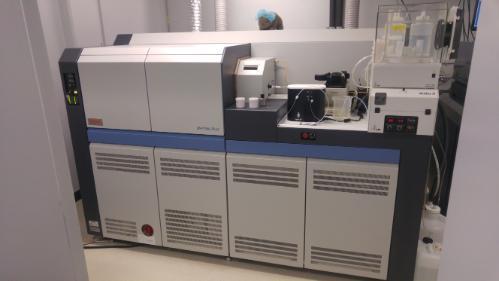
A Thermo Neptune Plus multi-collector inductively-coupled plasma mass spectrometer (ICP-MS).

This instrument is the top-of-the-range equipment for isotopic analysis. We have developed the measurement of Li, B, Cu, Sr, Nd, Th and U isotopes.
Several sample introduction systems are available, for solution samples: ESI cyclonic spray chamber, ESI Apex IR and CETAC Aridus II membrane desolvators.

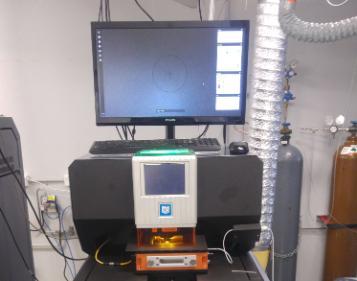
A New Wave Research 193 Excimer laser ablation system.

This laser ablation system allows us to perform in-situ geochemical analysis of geological, archaeological or biological samples. The laser can produce spot sizes down to a few micrometres. It is also equipped with the XYR aperture system, allowing us to generate ablation pits that are square- or rectangle-shaped. This is particularly useful when the aim is to sample a given growth band in corals or speleothems, for instance.
The NWR 193 can be connected to the iCAP-Q quad ICP-MS for element concentration determination or U-Pb dating; or connected to the Neptune Plus multi-collector ICP-MS for isotopic measurements, including U-Th dating.

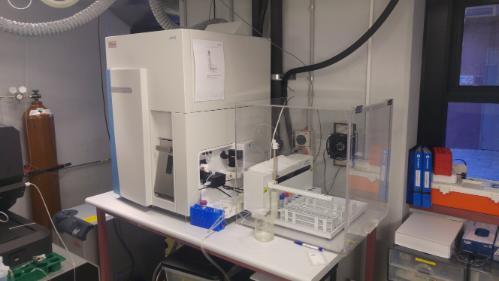
A Thermo iCAP-Q quadrupole ICP-MS.

This instrument determines elemental concentrations for metals and metalloids and can also be used for U–Pb dating.

A laboratory setup featuring a scientific instrument with a metal vent, surrounded by pipes and control knobs. The room is sterile and industrial./

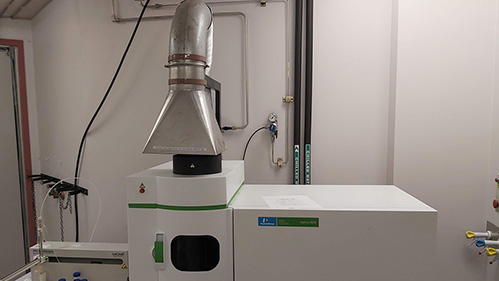
PerkinElmer Optima 8000 ICP-OES

This instrument determines elemental concentrations for major elements in a range of sample matrices including water, soil, sediment, plants and animal tissues.