


January 27, 2026
Lainie Anderson’s novels about a real pioneering policewoman invite us to play historical detective
Miss Kate Cocks, the real-life first policewoman in South Australia, is the star of Lainie Anderson's historical crime novels – with a Phryne-Fisher-like offsider.
It’s 1917 and policewoman Fanny Kate Boadicea Cocks is patrolling the parks of Adelaide, armed with a five-foot cane. She’s there to protect women from harm by enforcing a “three foot rule” to keep amorous couples at a safe distance from each other.
When not on morality police duties, she likes to shop in the recently opened Moore’s department store on Victoria Square, with its grand marble staircase, and its piano serenading the well-heeled clientele with cheery wartime songs.
This might seem like a fanciful premise for a historical crime fiction series. But Miss Kate Cocks, as she was usually known, did in fact exist. (So did Moore’s department store, before it was gutted by fire in 1948.) Cocks was the first woman police officer in the British Empire to be paid at the same rate as her male colleagues and granted similar powers of arrest.
In fact, she was the first policewoman in South Australia, which in 1894 became the first state to grant women the vote and the right to stand for parliament. (A year after New Zealand became the first country in the world to give women the vote.)
Review: The Death of Dora Black; Murder on North Terrace – by Lainie Anderson (Hachette)
Journalist and novelist Lainie Anderson discovered Cocks while randomly scrolling through her Twitter feed during the COVID pandemic. She then applied to the University of South Australia to do a PhD on Miss Cocks, aiming to make her the protagonist in a popular crime novel. This resulted in a two-book deal.

Anderson’s (still embargoed) thesis addressed the challenge, and ethics, of turning a real woman into a fictionalised character. Whatever her concerns might have been, The Death of Dora Black and Murder on North Terrace are fine additions to feminist historical crime fiction: perhaps best exemplified by the Miss Phryne Fisher mysteries written by the late Kerry Greenwood.
Indeed, Miss Cock’s fictional offsider, the indomitable Constable Ethel Bromley, is somewhat reminiscent of Phryne. Ethel is also wealthy and beautiful. She, too, entertains a lover and practices birth control. As one of Ethel’s aunts admiringly tells her: “You are our future selves”.
It’s a clever ploy, placing the “paradoxical” real-life character of Miss Cocks, with her reverence for motherhood and perplexing opposition to birth control and abortion, in a close working relationship with a character who embraces views much more in keeping with contemporary beliefs about women’s rights. This juxtaposition effectively stages a dialogue between past and present attitudes.
“In my opinion, a mother is the nearest thing to God upon this earth, because she, too, creates,” Cocks – who, in real life, founded a refuge for babies after her retirement – told The Advertiser in 1936. “That is why I am so opposed to all the abortive practices nowadays.”
But importantly, what Kate and Ethel share is their desire to protect women.
Revealing fashion and complex characters
While women may have achieved more control over their bodies since 1917, both The Death of Dora Black and Murder on North Terrace deal with crimes involving rape and domestic violence. Sadly, the persistence of these crimes today suggests the times may not have changed as much as we might hope.

The Death of Dora Black begins with the discovery of a young woman’s body under the jetty at Glenelg beach. The only clues are two small vials of opium and an expensive art nouveau purse. This is the motivating crime that will drive the primary narrative. However, it’s the incidental characters and descriptions of Adelaide that give these books their depth and heft.
Then, we are introduced to Miss Cocks as she shops in Moore’s department store for a pair of new shoes exactly the same as her old ones, but in a different colour. At five foot six inches, Miss Cocks is taller than the average woman of the time, and as “neat as a pin” in a “light green, ankle-length silk frock with an understated ruffle at the throat and a fitted waist”. Anderson’s fashion notes are precise – and revelatory in terms of what they might tell us about the characters.
Miss Cocks appears to be a 41-year-old, straight-laced, buttoned-up spinster. However, she is also a product of both her time and social circumstances – and all the more complex for that.
Ethel, on the other hand, is 27, exuberant and prone to wearing military-inspired outfits with much higher hemlines. She has also been learning jujitsu to great effect, having flattened a “mountain of a man” at the Port Adelaide docks who was pestering her. She would like to be a detective.
Over the course of the two books, set in January and September of 1917, respectively, Miss Cocks and Ethel’s working relationship deepens. As we are told in the second book, they develop “an unspoken appreciation of one another’s strengths and a sympathetic acceptance of their weaknesses” through their shared experiences, and the challenges they face together.
Murder ‘a welcome distraction’
The two female police officers are required to work an overwhelming 60 hours a week, with one Sunday off in every six. For the most part, this work is routine and exhausting. It involves daily trips to the Adelaide Railway Station to meet unaccompanied, vulnerable young women and ensure their future safety; walking the city’s parklands to catch couples in flagrante; and patrolling the suburbs to monitor domestic disputes. The murders they become involved in are something of a welcome distraction.
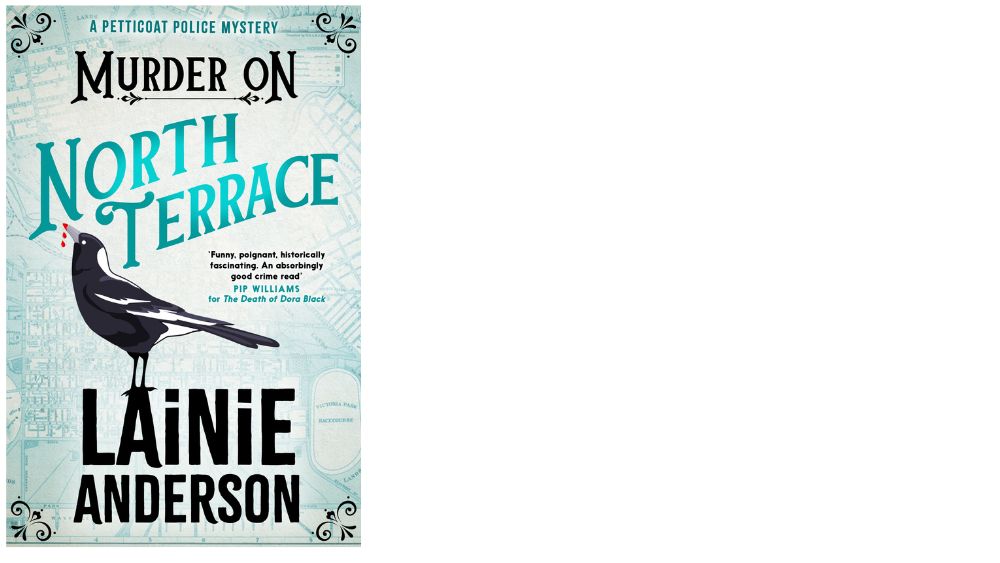
Anderson skilfully blends truth and fiction. The controversial painting, Sowing New Seed by William Orpen, did indeed exist. It caused quite a stir at the time, as did the case of the wife padlocked in the truck. Only the murder in the gallery is a fiction.
Real – and ever present – is the backdrop of the first world war. (This is also the backdrop of Anderson’s debut novel, Long Flight Home, also based on historical research and real people.) From the pianist in Moore’s department store playing Pack Up Your Troubles on repeat, to the returned soldiers in Victoria Square, “broken men with missing limbs and lost hope”, the impact of the war on the inhabitants of Adelaide is a constant theme.
In Murder on North Terrace, the war moves centre stage. Miss Cocks and Ethel are now on duty at the Cheer-Up Hut in Elder Park, a home away from home for new recruits and 300 recently returned South Australian soldiers.
As they watch a young amputee threaten to throw himself off a balcony and into the arms of a young woman he has just met, they are once again presented with forces beyond their control: including love, lust and the notorious six o’clock swill – not to mention a predatory rapist.
At least Ethel gets to play the detective, if only briefly. She also receives a marriage proposal – which completely confounds her, since this would mean resigning from the job she loves. Ethel may be a fictional character, but there’s a hard truth here. My own mother experienced it in 1937, when she was forced to give up her job in the United Kingdom as a result of a similar marriage bar.
Given the ongoing dialogue between fact and fiction, if I have any criticism to make of The Death of Dora Black and Murder on North Terrace, it is that they should have come with a map of Adelaide in 1917. I keenly wanted to trace Miss Cocks and Ethel’s movements through the city as they went about their business of saving women and solving crime.
Publishers take note: there’s the opportunity for a crime walk here. There, readers might investigate for themselves the relationship between the real and the imaginary that Anderson so effectively blurs. At the same time, she gives us a compelling portrait of what life might have felt like in Adelaide at that time.
Such is the power of good crime fiction that touches the heart as well as the mind – while inspiring a desire to play history detective.
Sue Turnbull, Honorary Professor of Communication and Media Studies, University of Wollongong
This article is republished from The Conversation under a Creative Commons license. Read the original article.
UOW academics exercise academic freedom by providing expert commentary, opinion and analysis on a range of ongoing social issues and current affairs. This expert commentary reflects the views of those individual academics and does not necessarily reflect the views or policy positions of the University of Wollongong.