


March 5, 2026
A wild girl considers land rights and community in Eva Hornung’s new novel
Ambitious in scope and its depictions of time, The Minstrels is "utterly gripping"
Eva Hornung was shortlisted for the Miles Franklin for her last novel, The Last Garden. The one before that, Dog Boy, won the Prime Minister’s Literary Award for Fiction and is now a Text Classic, introduced by Yann Martel.
Her latest centres on The Minstrels: a place that carries significant meaning for the local farming community and Indigenous community in and around the country town of Bolton. The Minstrels is a “half-chasm, half-gorge through which the river ran and then reissued, changed”. It’s “the site of various legends, some suicides, accidental deaths and many conceptions”.
Minstrels is the favourite word (“a dry, sibilant, singing word”) of Gem, the novel’s wild-spirited protagonist, who we follow from childhood. The Minstrels are on the border of her family’s land and a neighbour’s. Gem trades access to it for the local Aboriginal community with elder Uncle Jim, who shares language and place-based knowledge with her in return.
Review: The Minstrels by Eva Hornung (Text Publishing)
Gem and her relationship with place – her connection with the land where she grows up – drive the novel. Hornung also explores Gem’s relationship with community and tensions around land ownership. Questions emerge about access and the responsibilities of caring for place.
But Hornung’s novel is really about the characters who live near this emblematic place and the changes they undergo as a consequence of their time there: Gem and, to a lesser extent, her brother Will.
Difficult dirty girl
The Minstrels is ambitious in scope and its depictions of time. It follows Gem from a small girl growing up in her close-knit town, to the family’s forced sale of the land, her time at university and her eventual return. It stretches back to a past when mothers dressed up for Saturday fish and chips, wearing gloves and seamed stockings – and forward to include a near-future that hovers between realist and speculative fiction.
“It’s the fiction writer’s task to put the reader through the strangely desirable misapprehension that three decades have passed during the five hours it took to read certain pages,” writes novelist Joan Silber in her book, The Art of Time in Fiction. In The Minstrels, Hornung does a stunning job of this.
Her novel’s pacing, and its balance of showing and telling, voice, character and plot all work together to give the reader the sense of a whole (complicated, endearing, empathetic) human life, in the course of 350-odd pages.
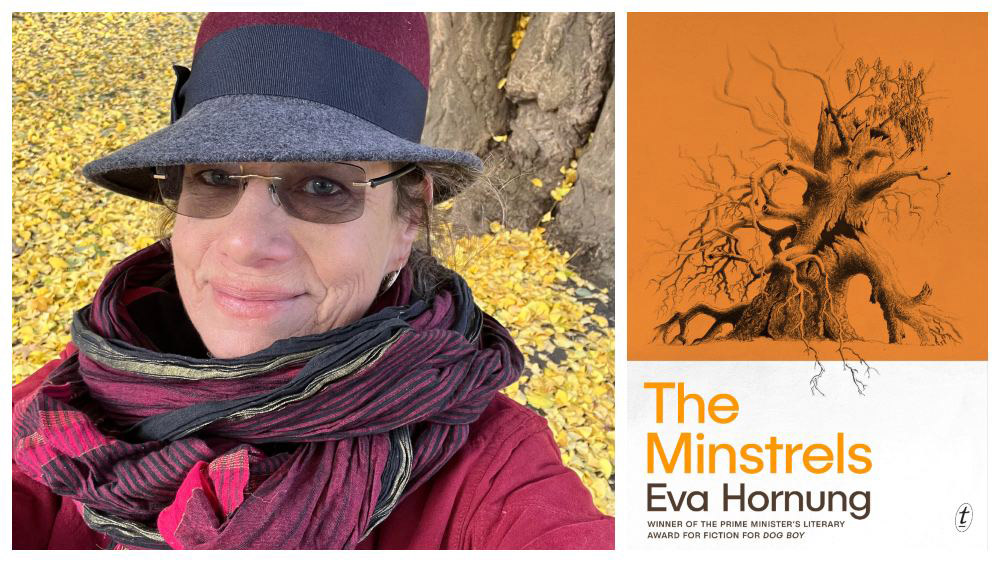
The Minstrels begins with a typical Saturday in Gem’s family, one prone to secrets. The loving, but complicated relationship between Gem and Will, who she comes “a long way second” to with her parents, is explored. Will sees himself as “an ordinary boy with an extraordinary sister who was all his own”. Their mother sees Gem’s place differently: “Her perfect family now had a difficult dirty girl permanently attached to it.”
When family secrets surface, the siblings’ relationship – and the familial bedrock they take for granted – is irrevocably affected. Gem and Will take separate paths in the novel’s second half, but there is a sense the brother continues to look after his sister. Despite everything, they are a team.
‘White benefactor’ or ‘very bad’?
We see Gem navigate, then question, her role as white “benefactor” in her friendship with Uncle Jim. “This is my grandmother’s country,” he tells her as they strike their deal. “And it is all privately owned. We have no access.” Gem immediately reflects: “this was a mystery she hadn’t even known about”. But on one level, she’d always known.
It had been true all her life, an ever-present, unremarked normative fear breathed in and out without words. Another thing everyone didn’t see but knew was there.
Early in their exchange, Gem notices Uncle Jim “eye her coolly and without apparent gratitude for all her generosity”. Part of Gem’s reckoning with her settler legacy is bound up with understanding herself as utnyu, which translates as:
Whitefellow/…//corpse; dead (ghost/body); very sick; very bad; white person.
Hornung navigates this tension well, showing Gem’s struggles, vanities and deeper learnings. The friendship that eventually emerges is profound. As Uncle Jim tells her:
I’m interested in my country, and you come along with it. Turns out you’re inseparable from it.
Land rights in an imagined future
At one point, animal activists target Gem with camera phones and online campaigns – and life-changing relationships form. Respect and care bridge differences of opinion. The deeper point made is that care should be extended to the beyond-human.
But the reader never quite knows why Gem was targeted when there are so many farmers in the area. Sometimes, I felt the book was driven more by the issues it explores than its organic story: this was one of those times.
In another episode, an immigrant family takes shelter on Gem’s farm, building a small rock hut by the river – and departing as quickly as they arrive. The notion of land ownership is prodded and questioned, sometimes from multiple angles.
Later, in the novel’s imagined future, the gulf between city and country communities widens. New legislation affects land rights. City folk can access farmland – and do, for eccentric gatherings. Gem is – perhaps conveniently? – receptive to people who come onto the land and the communities she comes to know.
Narrative space is mostly dedicated to scenes that illustrate positive experiences: where individuals appreciate and care for place, and a sense of community develops. Darker situations, such as when Gem is forced to hide in her cellar, waiting for squatters to move on, are not explored in the same depth.
In a book that questions settler perspectives on land ownership, community, human relationships and safety, this weighting seems disproportionate.
I found the near-future section of the novel utterly gripping. In one sense, this imagined future is frighteningly realist: land ownership becomes a product of might, as the artifice of the legal contract is revealed. No one cares what is written on a piece of paper or inside a computer when the internet is inoperable and the world follows different rules.
We see glimpses of this new order from Gem’s perspective – but I did wonder if her lively spirit wouldn’t be more curious than she is about the new world beyond her boundary. That said, Hornung grapples with complex issues without relying on overused tropes or sentimentality. And the novel’s language is beautiful.
Gem proves a character of grit and independence, strength and fierce intelligence. In The Minstrels, we witness her full and complicated life, and her profound relationship to place. This was a compelling read.
Shady Cosgrove, Associate Professor, Creative Writing, University of Wollongong
This article is republished from The Conversation under a Creative Commons license. Read the original article.
UOW academics exercise academic freedom by providing expert commentary, opinion and analysis on a range of ongoing social issues and current affairs. This expert commentary reflects the views of those individual academics and does not necessarily reflect the views or policy positions of the University of Wollongong.