
2023 National Reconciliation Week at UOW - Session 1
In this session, we discuss why non-Indigenous Australian’s should not fear an Aboriginal and Torres Strait Islander Voice to Parliament. You will hear from non-Indigenous UOW academics around the Voice to Parliament, how it will affect constitutional law, the economy and United Nation's Sustainable Development goals. Our academic’s will address some of the myths that have been circulating during this campaign.
I've got a story to tell you. It's a good one. It's about how these people, the first people got a voice.
60,000 years they've been speaking. At 363 languages,
but no voice, no say in matters which affected them. It wasn't right.
So me and your granddad, they and your mum. The whole nation did something about it.
People call their friends and families. People talk about it on the streets. Talk about it at work on the field.
Everybody made a song and dance about it. Everyone worked side by side.
And that's how we changed this country for the better. How we made history.
It's the story true. It could be.
Thank you everyone for coming today. We're really lucky to be having this event today on Aboriginal land,
and I want to acknowledge the traditional owners of Wollongong and also I was a student here, so I had the privilege of studying
on this magnificent campus, but also down in Nowra as well. So UOW has campuses across the state.
So acknowledging all mob and traditional owners that the campuses reach out to and the whole Illawarra are Aboriginal community.
It always was and always will be Aboriginal land.
I'm really excited for today's panel. We have some esteemed panelists, some which used to be my lecturers,
which is fun that I get to ask some questions this year. This time around I've been waiting for this moment
now that seriously, it's great to have you all here. This year, all Australians, we asked a very important question,
so it's really important we open up these dialogs and it'll be a change to the Constitution and everyone be asked
whether First Nations people should be recognized as First Peoples Through a voice to Parliament.
And that's what we hope to unpack today. So thank you for those here that are joining in person.
And also we have people joining online as well
and so yes, we do have a slido that will pop up on the screen both virtually and now it's up on the screen there.
So if you do have any questions that pop up during the talk, please put it
through there and we'll get to them at the end so this session will be sort of covering,
although this change obviously impacts Aboriginal communities predominantly is a change to the Constitution and it impacts all Australians.
So we have a great group of academics here at UOW, non-Indigenous academics,
so give us their expertise and opinions on a couple of different topics
and across different expertise as well. So my name's Adam,
from south west Queensland. I grew up in Canberra on an all ngambri country
and now I'm up in Sydney on Gadagl country and I think just in that shows the diversity of our peoples as well, which hopefully
this voice can represent. I'll introduce the panel by letting them introduce themselves.
I know very lazy of me as a panel host but we'll start from this way.
And Belinda, please introduce yourself how you'd like to be introduced. Thanks, Adam. Hi everyone.
My name is Belinda and I was born in Wagga Wagga and I would like to pay respects to the Wiradjuri people,
the traditional custodians of the place in which I was born. Thank you Belinda My name is Neve Kinchen.
I was born in Ireland and I'd like to acknowledge the people who are the traditional custodians of the place where I was raised.
My name is Alfredo and I was born in Manila in the Philippines, and the Negrito were the Aboriginal people
in Manila. My name is Trish.
I was born and raised in Mount Druitt in Western Sydney, and I would like to honor
and pay my respects to the Durag people who are the traditional owners of the land on which I grew up.
Yeah, and they all excellent academics as well. All of that talked to and I had great bio's but I won't go through them.
You can sort of explore that when we get to the questions as well.
So again, the slido is there get on to it. If you have any questions, as I'm sure much you might actually come in
with questions as well. So if we don't address it through the panel, we'll be sure to pick it up
as well with the password of hashtag UOW. So I think it would be quite good to just jump in
so we can make sure we can address any questions that come through and we'll start with you, Trish.
So, Trish. You and a small legal team were engaged by the Vice-Chancellor
to investigate the Uluru Statement the constitutional reform proposal
and how it impacted the university, UOW. Can you just describe that journey
that you undertook in order for UOW to solidify our position, meaning
the University's position to support the Uluru Statement from the heart? Yeah. Thanks.
Yes. And I think actually is an important first statement is to say that actually that that small legal team was brought together
at the initiative of the Vice-Chancellor. And I think actually that leadership has has actually been really instrumental
and important to recognise the so the Vice-Chancellor brought together, I guess key people that she felt really
I guess had a contribution to make. But also I guess could look at some of the obstacles and opportunities
for UOW in this move to decide about supporting the statement or not.
And I think, you know, that that team myself, I was Dean of law
at the time we had Greg Rose who was our then chair of Academic Senate.
We had Coiln Picker who is the Executive Dean of BAL and also Meg West, who was the
General Counsel of UOW. So by coincidence, we were all lawyers. I am not sure that that was designed that way, but but that's how it how it worked out.
And I think that team of people really decided that there was no obstacle really to UOW
supporting the statement and the associated constitutional reform.
And I think, in fact, what that team, while recognizing that, of course, this was political,
but as an institution of higher education, that in fact, the university had a great
responsibility and opportunity to actually play a role in education
and as an institute of higher education that that actually the statements and, you know,
the constitutional reform to recognize our First Nations people, in fact, aligns with the university's values and with our stated,
championing of equity and social justice. So, in fact, we saw that it was it was really critical and connected
to to who we were as an institution. So in terms of the
and I guess also I will just say that it really also went hand in hand with the work that we were doing internally within the university
through our reconciliation action plan and some of the ways in which we were embedding First Nations culture within the things
that we did within the university, I can point to our graduation ceremonies is actually one of those really powerful examples.
So I guess key to us thinking about next steps in realizing our support
for the statement and constitutional reform or recognition
was the recognition that we needed to walk together, that this was a shared path
and that we needed to actually walk beside First Nations people in this space.
And as a shared path that we needed to listen to our First Nations staff
and students and actually work out a plan moving forward together. And I think the first thing that we did was have that conversation
with Woolyungah Indigenous Center about how we move forward we then moved through getting formal recognition
at the university level, through academic Senate, through University Council and the Council and Senate
unanimously....well, actually I, I can't hand or not say
it was unanimous because I wasn't there, but there was endorsement all at both Senate and Council for the University's support
for the statement and, and constitutional reform. And I'm incredibly proud of that.
I in terms of after the formal endorsement phase,
I think then we went about really creating opportunities for people to learn about what the statement was all about,
what the constitutional recognition and the voice was all about. So we had a number of different, you know, forums throughout,
you know, the time where people could ask questions and learn about that.
And I think what has also been really fantastic is our current online community
called Yarn Up, where we've got 300 plus I think from memory people, staff and
primarily staff, but perhaps students as well, but primarily staff who have joined that online community.
And we're actually sharing knowledge and information about, you know, events, events like this.
So it's been incredibly powerful. And I think from my perspective, is just a final piece
that I will say is that UOW had this kind of formal endorsement or support for the constitutional reform
really for me reflects commitment on two levels. First, it's a recognition of our responsibility
and the opportunity that we have as a higher institution to to be able to educate and to play a part in truth
telling more broadly and support that. But as I said internally, I think really important to,
the work that we're doing to make sure that we are creating a culturally safe space for our First Nation staff and students.
Thanks Trish It's really good to hear that sort of long story of how UOW came to that position.
And as a former student, you know, I'm proud to have the institution back something quite formally and as well and to speak about reconciliation.
So I should acknowledge that it is Reconciliation Week in this event is part of that. And we do have additional panels that are focusing on the voice as well.
So I do encourage if you're not signed up to them to go to it, that includes one with Jeff Scott,
who's been around Aboriginal affairs for a very long time, and he's doing a lot of work with Uluru dialogs.
And then we have an all Aboriginal panel as well. So just jump on the website and sign up to them because you know, UOW
does have a really good commitment to reconciliation and through the leadership of the Woolyungah Indigenous Centre, and Jamie Beveridge, it's been really great to see
where the university is going with that all. So Neve,
as a law expert have you come across any discussions either for or against around
embedding of voice to Parliament that you feel needs to be debunked? We know this conversation is sort of heating up in the public come
there's a lot of different claims going around from your expertise. is there anything you think?
Yeah, there's a lot going around, but I'd like to focus on two. The first is the inclusion of the words executive government in the provision,
in the respect that the voice will be able to make representations to the executive government
first. It's really important that the voice is able to make representations to the executive government
because it's the executive government that formulate the laws and the policy and implement them.
So then what does will this mean that the executive government will and the Parliament will be obliged to follow the representations of the voice?
The provision doesn't actually say anything about how the voice is to be received. It doesn't create obligations in relation to following what the voice says.
They made itself termed in language of representation. However, that isn't going to particularly prevent
the Parliament from creating legislation which says that in some certain contexts
the voice representation should be taken into account. And there's no doubt that the Parliament will do that in certain
contextual situations. So what's that then? The what then is the implication for litigation and the High Court?
Does that increase the chances of litigation? First of all, in relation to the executive government,
you don't just challenge executive policy for a start executive governments policy. It has to be part of some kind of dispute
where there's one or more parties involved. So there has to be a dispute first of all, and someone has to have standing
or has to have the ability to actually take that dispute to the court but let's say we get past that.
Much of what the executive does is what we call non justiciable in the sense it's actually not appropriate for the courts to to actually consider it.
What the executive government does is often highly political, polycentric, complex
cases, say, for example, which isn't particularly relevant here. Are international relations.
The court will not consider those things. What the court says is this isn't appropriate for the court, this is appropriate for the executive government.
So many of those things will not come before the court, but in some cases they may.
What will happen there is the court will ask itself if the legislative context is appropriate,
did the decision maker take the representation of the voice into account?
And that means did the decision maker turn their mind to it? Did they consider it?
Did they weigh up the evidence in relation to what the representation was? If the court says the answer is no, what the court then does is
send it back to the decision maker and say, remake this decision. Taking into account the representation for the voice,
the court will not say what the outcome of that decision will be. So we have a very established system that actually prevents
a flood gates, which is the argument that's comes up there's no sense that lawyers are going to be walking into courts
and slinging the mud at walls and seeing what's going to stick. Lawyers know that they need to have reasoned,
reasoned arguments that based on based on those things that I'm talking about or they don't get through the front door of the courthouse.
The second issue that I really wanted to talk about was the contention that it creates a racialised constitution
and confers racial advantage to one group over others.
My first point is that that this is not about race, that giving Aboriginal and Torres Strait Islands a voice in Parliament
is about recognizing that they are the first peoples of this nation and that accords with United Nations principles and recommendations
to work towards self-determination for indigenous people. The second thing is calls that this may cause our racialized constitution
completely disingenuous when race is already in the constitution. There is something called the race power, which gives the Parliament
the ability to make laws special laws that are necessary in regards to race already.
There is also another section in there in this in the Constitution that's around race, which is broad, it's largely redundant, but it exists in there.
So then the question is, is does this confer disadvantage on non-Indigenous people?
And the answer is simply no. It takes away no rights of non-Indigenous people and it confers no new obligations.
And then the final question has to be does this confer advantage on Aboriginal and Torres Strait Islander peoples?
The reality is, is this is about equity of participation in legal processes and that is not just formal equity.
It has to also be about recognizing where there has been marginalized voices and raising those marginalized voices up.
And the High Court recognizes that as well. Oh, sorry, I just lost my train of thought and I knew that I would do that in
just a moment. Sorry, yes. So of course Aboriginal and Torres Strait Islanders voices have been
completely marginalized prior to 1967. They were actively excluded from parts of the Constitution.
Despite all the best intentions of the 1967 referendum. The race power still exists in a way that there is an ability to create
detrimental laws for Aboriginal and Torres Strait Islander peoples because the High Court has left that wide open
and there's no positive recognition of Aboriginal and Torres Strait Islander people and you know, if we had had the voice in 2007 then Aboriginal and Torres
Strait Islander people would have at least had a say in the NT interventions. So this is not about conferring advantage, it is remedying disadvantage.
Thanks Trish. And with Reconciliation Week that did start off with marking the 1967 referendum and then there has been conversations
about how this may pull that back and I think you addressed it quite clearly that in fact that referendum simply entrenched
that power really just transferred to the the Federal Parliament
so yeah and it's only ever been used for Aboriginal and Torres Strait Islander people as well. So that that's how it's been used in the past.
We'll now go to Alferdo Make me proud.
I'll be I'll be sending remarks later but do you see any economic
impact for society with this change. Right. So I guess I should first preface the answer by saying that I am coming
from a country that was occupied by foreign nations as well. First the Spanish, then the British and the Spanish.
Again, and the Americans and the Japanese and the Americans again. So I do share the the generational trauma and the
with the Uluru statement from the Heart, the torment of powerlessness that has brought forth this call
for recognition by Indigenous Australians. And I think the voice of Parliament represents a significant,
crucial step towards empowering the Indigenous Australians so they can control their economic lives.
But to be honest, it's difficult to provide any evidence on the economic impact of the the voice of Parliament.
I am not aware of any studies that have been performed ex-ante and studying it exposed is also a difficult
to undertake thing, right, because of something that statisticians and economists call the fundamental problem of causal inference, right?
You would need to observe two versions of Australia, one with a voice and one without the voice and track economic indicators over time.
But of course there is only one version of Australia at any given time.
Right? So it's a difficult undertaking to evaluate and expose right, however
there are other areas of economics that we can draw lessons from, right?
So economics is a very broad. We look at, for example, political economy. We look at new institutional economics which really examines
how institutions are organized in society. And how they can deliver economic impacts.
And from that literature we can draw some lessons, right? So one lesson is looking at the abolition of apartheid in South Africa.
Economists like looking at utility. Of course, utility is very difficult to measure. So we ask questions instead that pertain to life satisfaction.
So you would be asked a question in a scale of one to five, how would you rate your life in general
with five being the most satisfied, one being the dissatisfied? So we do observe an increase in life satisfaction at the end of apartheid
in South Africa. But the question that economists would ask is, is that because of better outcomes that,
you know, underrepresented minorities in South Africa experienced or is it because of increased representation in how they determine their lives?
Well, as it turns out, it's both right. Of course, people are much happier if they are better off in society.
But also they were much happier because they were able to participate in things that determine aspects of their lives.
What economists call procedural utility. So utility not just derive because you are richer, but
because you are able to participate in making the decisions that made you richer.
Right. Of course, dictatorships and democratic governments can in principle achieve the same outcomes.
In principle. But as it turns out, things that are achieved through democratic means
value are valued much more by people than those that are dictated upon. Right.
Another thing that kind of like addresses the problem of causal inference head on is the right, of course,
a randomized controlled trial, which political economists have done. And they look at it
particularly separating the mechanism of vote versus the Voice.
And I will, you know, paraphrase in their study, the crucial factor that determines
the efficiency of the organization is not so much whether people can vote, but rather whether they were consulted or the Voice right.
So all this to say that it's a difficult question to answer when we're seeking evidence for the economic impact of the Voice
but I think that question misses the point entirely, actually, because the strongest argument for the Voice is not utilitarian.
It's not consequentialist it's not whether it can deliver the best economic outcomes. I think the strongest case for the Voice
is that it is a recognition of the special status of First Nations people in Australia and their recognition of the historical
and contemporaneous injustices that they are experiencing. So I think through the Uluru statment from the Heart
and the Indigenous Voice to Parliament, Indigenous Australians really are calling for a new era of economic opportunity and equality
that benefits all Australians and I think we should listen. HD, that was really good Good. Thank you.
There was a bit there. I'm like feeling like my lectures, but we go back. Thank you. I'll take my HD.
I'm like correlation, not causation. I was back there, but you know, it's really useful and you
because there is a lot of misinformation out there and this happens with Aboriginal affairs
when anything, any changes proposed suddenly becomes back to sort of what happened around the native title of Aboriginal people.
We advocate people out of their homes and that sort of thing. So I think also
I know that's not really an economic question that challenged me, but I think it's good to point out
that it's not really an economic change. It can influence the changes, particularly in the institutions of Australia,
because it does that by definition. Yeah. Thanks for sharing that.
We'll get Belinda on now. I know Belinda as well.
We did some work together actually, so I do get around a bit,
but you're an expert on the UN Sustainable Development Goals, so I'm really interested.
What will the referendum and the constitutional reform, how will that support or advance any of those,
that sort of infrastructure or any of those goals? Thanks Adam. I would just firstly like to acknowledge that the beautiful land
on which I'm very grateful to be on today is Aboriginal land and pay respects to Aboriginal colleagues that are in the room and online
I guess. Not sure how we define expert, but I'll give it a red hot crack.
As you know, many of you know in this room, the SDGs are all about improving people's lives whilst protecting our natural resources
and they, they do this. The framework does this. It cuts through divisions of development, politics, economics,
it cuts through sectors, it cuts through religions. And it cuts through through, through race.
And it asks us to come together and collaborate and partner
to work together on some of the most significant challenges that our generation will face.
The UN acknowledges that, you know, we will not truly achieve sustainable development without protecting our traditional knowledge systems.
And so the referendum and constitutional reform is all about protecting our First Nations peoples knowledge
systems. I guess if we think about, you know, the Sustainable Development
Goals, in particular sustainable development, goal for quality education.
We are already advancing and supporting that sustainable development goal by being here today and we are having a conversation
and we are all learning more. So yes, the reform and Constitution will
advance and support the Sustainable Development Goals from a quality education perspective.
Our First Nations people being able to have a voice for us to be able to listen, hear that voice and take that advice.
Hear their stories, their songs will enable us to learn more about our environment and learn more about our nation's history.
So SDG four is a big one. I wonder what came to your mind
when you guys listened to this question. Have you got any
Carly? Call me. Give me one. More.
Probably I would say 13 is probably climate action is the one that actually comes to mind.
First it's it's the one that we're all thinking about at the moment. So our First Nations people have ancient knowledge,
ancient through generations of sustained communities that have lived on our country for thousands and thousands of years.
And that and those generations have so much knowledge about the relationships that humans have with the environment.
And we need to hear that and we need to listen to it and we need to take that that advice
so the voice will strengthen our capacity, our adaptive capacity to climate
related hazards and natural disasters. SDG 15 life on land.
Our First Nations people are our de facto guardians of biodiversity. We live in a country that has thousands of unique species
of of animals and plants. And we need to listen
you know, to those things that are that are going extinct and and that are under threat.
So we need to listen. And the voice will ensure that their advice is heard so that we can conserve
resource and sustain, I guess, as we move forward and live and want to live, you know, on this country
is SDG six clean water. I could go on forever, but I'm only going to do a couple
so six water is our most precious resource if we don't have it, there is there is nothing.
First Nations peoples for thousands and thousands of years had know how to sustainably use water.
OK, so these are some of the topics that are coming up is SDG 2, zero hunger.
And getting the balance right between what we eat, our food, the ecosystems, what we grow, how we grow
and of course SDG 17, which is partnerships that's a big one, how we work together
and how we come together because this this planet is at risk and we are facing many slowly creeping crises
that, you know, we say a little bit, but underlying they are forever growing.
So I feel that it is our it is our responsibility to give our indigenous people a voice and ultimately will be
for the wellbeing of of our planet. Yeah. Thank you. Thanks. And I think it's also good to sort of ground the conversation
around the voice, around the process that has led us to this moment as well.
It's not something new. It's been well, even in the constitutional sense, it's been a decade of different processes, including the dialogs
that led to the statement. And although there is diversity in views in Aboriginal communities as well,
you know, it is one of the longest processes that have have occurred. So it is a proposition that's been put forth by Aboriginal people too
and that plays I think an important factor this next question is going across all four of our guests
and it's a pretty simple one but an interesting one. So I'm looking forward to hearing your perspectives on it.
You can either take that from your academic perspective or add in your own personal views outside of that doesn't,
doesn't have to be a scientific experiment. You don't need a paper Alfredo, I'm
sorry, I'm enjoying this too much so we'll start
with Tricia and then move along. But the question is if the yes, vote is successful
and the constitutional change comes about, how will impact non-Indigenous Australian people.
thank you. I'm being optimistic and I'm not saying if I'm saying win because I truly believe actually that it
will happen. How will it impact non-Indigenous people?
Look, I actually think it will impact it significantly. Of course this is about giving a voice to
Indigenous people through the constitutional reform process. But I think the really in order for us to achieve reconciliation
or meaningful reconciliation in this country, we actually we,
we need to do that from a place of respect and from a place of,
of, of mutual respect and working together. And to me what the, what the voice does is it,
it is a platform to acknowledge all of the past injustices.
It's a platform for truth telling. And to me that is a necessary
critical step in order to achieve reconciliation. And we will all benefit from reconciliation.
But it can't happen until, I believe, and certainly what I feel like I hear
is, is the is the truth telling and the platform to really
for First Nations people to really put forward what it is that they need and to have us listen.
Alfredo Now I'm going to be struggling. No. Well, so I am an economist. Right.
And one of the if anyone is taking econ 100 the first lesson in economics is resources are scarce.
And I link that to kind of what I was saying earlier in that having a voice,
we have a very long and wide literature that looks at inclusive governance
and stakeholder engagement and how it impacts on organizational efficiency.
Having a voice, I think, will make governments much more efficient. Right.
And to the extent that efficiency means savings, that will allow many more resources to be spent on things that we think are important.
Right. So even for things that are matters completely within the purview of non-Indigenous Australians, to the extent that the Australian Government
can save resources that will matter to them it is not something that you can sort of overestimate that importance,
especially now that everyone here is acutely aware of the problems of cost of living,
people struggling to pay rent, people are struggling to find housing
and a much more efficient government a much more efficient government that decides where to spend money most productively
will benefit not just the Indigenous Australians, but also the non-Indigenous Australians.
So all Australians really will benefit from from that and that comes from primarily
having the consultative process that the voice will enshrined in the Constitution.
So that's a very crucial point. Yeah. Yeah. And I think what you're sort of speaking to relates to what's really laid
out in the rights to Indigenous people through the United Nations, that of self-determination and being able to have
consulted on anything that impacts them. And that's really what the voice is about.
I mean I think from a law perspective and a constitutional law perspective, I spoke to this anyway because I think it doesn't really it doesn't
impact any obligations or take away any rights of non indigenous people. It introduces some legal principles that are part of our normal legal system
that would just need to be taken into account. But that's, that's the way it works. That happens all the time. So I don't see that.
But I think more broadly, I think for those of us that support the voice and support social justice, it
it allows us or perhaps it firms maybe or steps towards the Australia that we, we want to be
and that we see ourselves as and we are able to maybe stand a little taller in the international space when we look at ourselves in the mirror.
Because I think for many of us, like I say this, sometimes I feel so out of touch with what the Government is doing.
Certainly in the last few years and it doesn't seem to represent me. So I think we can just just be a little bit prouder of who we are
and maybe affirm with our own values so yeah, I just think that's a that would be a really positive thing for ourselves as our national identity.
Yeah. I guess for me is a bit of an analogy. I remember when, you know, during COVID and you know,
we turn on the TV every morning and you know. What. I know? Remember, PM was, you know, on in government at the time
and he would stand next to the chief financial officer and we would also have the hearing aid person standing next to them.
And I remember, you know, we would watch that and you know, probably for the first time in my generation, would you have
a prime minister standing next to a chief medical officer and listening to the chief medical officer
and taking advice because he didn't have the answers. And I think for me, I see it.
I know it's very different, but I do see it in that light in that our federal at that federal government level,
they are making decisions without the information that they need. And so I see I see it like that.
You know, whether it's on the TV like that, it should be. But that's how I see the conversation happening.
And that's what for me, as a non-indigenous person, that's what I that's what I want to see.
I want to see them listening because our country is in some serious, serious problems.
And we need to listen to people who have been there here a lot longer than us. So that's how I see it impacting us.
Yeah. And I think again, to go back to the or his statement, it was that invitation to all Australians.
So it really has always been about inviting Australians to walk with Aboriginal and Torres Strait
Islander people because we recognise that's the way we've got to move forward. And this is one step in a long,
long process. We've come
to the conclusion of my questions, so we've already got a few coming in.
But please add on to the questions and we do still have a bit of time to get to quite a few.
So we'll start from the first question that we got through
and I'll just read out. The Statement from the Heart calls for the Voice and Macchiato,
which is truth trailing in treaty. The no case is already littered with historical inaccuracies.
Well, what role does a panel think the University of Wollongong can play or should play in truth telling?
Great question, Dave. I think that was really good. So I'll open up to everyone.
You can give an answer, but who wants to go first or I'll pick someone because I got the power.
I'm happy to say a few words and I guess I'm I'm speaking or the answer I'm
providing is perhaps from the context of when I was dean of law.
So the law school has, you know, I guess long supported the statement
and certainly we made submissions. I can't recall if I mentioned this, but we, we
the law school had made a submission in support of the statement and
calling on the government to prioritize consultation with First Nations people around what the voice would look like.
So for me, you know, it is really critical that, you know, the university
does play a part in this space, and I think it is very well placed to do so.
And certainly from the perspective of the law school, we see this opportunity through our curriculum so at the moment,
you know, the the law school is really doing an audit of its curriculum, looking at where opportunities are to embed
in the curriculum, this this truth telling in a sense that at at all levels.
So for me, it's critical and there are so many opportunity is and and I'm really proud of what
the university UOW is has been doing over the last of the last few years
in this space, taking those steps along a long way to go.
But I feel like we have really prioritized partnerships working, walking together and working together.
And and, you know, we are taking those baby steps and there's a lot more to be done.
But the critical role. Does anyone else have anything on it
it was a it was a good answer, HD! I'm just seeing how long that joke can run for.
So we got another good question. And I'm sure many in the audience would have seen this come up either
through the news or different panels. Will the will constitutional recognition
of First Nations people compromise sovereignty? And I guess in that sense they're talking
about Aboriginal and Torres Strait Islander sovereignty. I might take this one
first of all, this is a really complicated question. It seems to be it seems to be simple, but it's absolutely not,
part of the reason is that is because the way that Aboriginal and Torres Strait Island sovereignty is actually there,
different ways of looking at it across communities, but essentially so if we start with the fact that obviously Aboriginal and Torres
Strait Islanders sovereignty is about the connection obviously to
to custom and land and country and that it was, has always been here
so sort of false flags like terra nullius and that those principles we know we disregard those, it's never stopped.
There is a thinking that sovereignty of Aboriginal and Torres Strait Islanders people exists alongside the Constitution and what needs to happen
so that it's never was never gone and it has always continued alongside. And so what there needs to happen is just better ways to
recognize that sovereignty. So through laws, through practice. So if we take that perspective and that's exactly what the voice is
doing, it's further recognizing Indigenous sovereignty. But I have to acknowledge that there's a different type of sovereignty
and the more the Western style type of sovereignty where it's about power and autonomy in an international law space and there are some discussions
around Indigenous sovereignty that is more along those lines
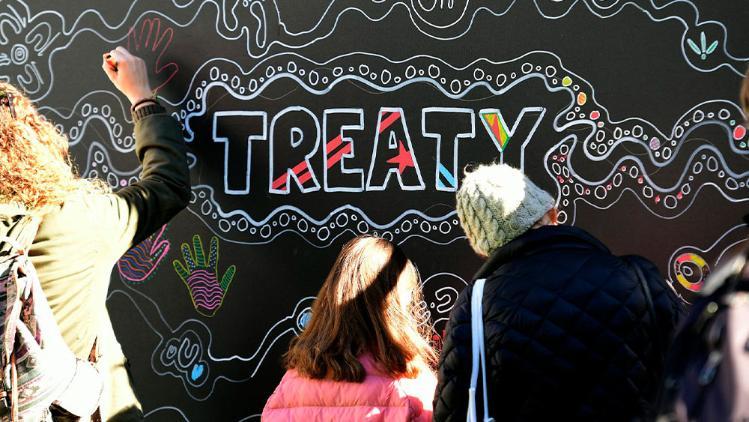
so that is where we see discussions around treaty and that's something that I don't want
to particularly talk about except to say that bringing the voice into the Constitution in no way prevents a treaty.
So this is not those two things. Don't particularly talk to each other. The treaty is something that the executive government will decide
upon, what will enter into and what that looks like. It's a separate thing. So whether that happens or not, the voice is not going to impact that.
So it is a little complicated because I said that it's the complicated view of what sovereignty Aboriginal and Torres Strait Islander sovereignty is.
But I don't see the voice in either perspective taking away from it.
Thank you. That's great. And I think through the parliamentary process, a lot of the legal experts
have really explored what you just spoke to in really clear ways. If anyone has time and it's a nerd, you can go back
and watch them as well. We got we got another question.
Thanks for sending the questions through
Apparently the Liberal Party Party have taken a no position on the voice.
Is this purely political given that there's been so many benefits to representation for Aboriginal and Torres Strait Islander people
and all open it up or it's a big one.
It's not I never imagined myself in the position of Peter Dutton.
Yeah, I. Well I think it is, yes.
I mean I think that's the clear answer because I don't see, I don't see why that, that why there is there against the.
Yes, basically there's no there's no because of the reasons that we've discussed because of, you know, the constitutional reasons,
those sorts of things that I was trying to debunk are easily debunked. The the Voice is actually a very conservative constitutional change
and they know that. But the way the politics have evolved in recent years is that
parties are very responsive to their their electorates and the people, you know,
we see seeing the rise of populism I'm not particularly saying goes this far, but I cannot see that
it's just that it isn't political, that they are responding to what they believe their base wants, essentially.
Yeah. And so I just just also the point to say that to not support the voice is also political.
I mean, yeah, both both of those things are true. And I think this point. Is a good one
From a different not from a legal perspective whatsoever. I just think it is interesting, you know, from a non-legal perspective, you know, to watch this play out
you know, you know, in our house with, you know, with, with our children and to watch, you know, the Liberal Party
bring Aboriginal people into this discussion to have the counter argument. And so I think it's important that non-Indigenous people,
you know, don't speak on behalf of Aboriginal people. You know, we're not Aboriginal or Torres Strait Islander and so I feel,
yeah, that's really, it's really important that even
he has, that he's speaking about it to be honest. And he's speaking very loud.
And so yeah, that that's I think that's interesting too that, that the respect. Yeah. That we're, that, that we're playing the yeah.
And I think it's always good to remember that its a referendum, so each of us, if we're enrolled to vote, we'll have our moment in that ballot box
and it's ultimately up to us and not what happens in Parliament.
So another one we got here is what do you suggest, and you've sort of spoken to this a bit in your answers already,
but I'll ask a bit more explicitly, what do you suggest non-Indigenous people need to do now until the vote
in relation to educating and supporting the Yes vote
and I want to pick on Alfredo.
I think it's incumbent because it is a referendum, right?
There is a shared responsibility to educate each other on, on the issue.
And I did mention at the start I come from the Philippines, right? So I went to the University of the Philippines, the very kind of left
of Center University, a home for scholar activists.
And in 1972 Ferdinand Marcos declared martial law right. And you know, this is not a dictatorship that we have in Australia,
but I guess sometimes it might feel that way to those that are dispossessed.
In the campus newspaper, the Philippine Collegian had this front page story
in 1976, four years after the declaration of martial law and the question that was asked by the then editor in chief Abraham Sarmiento
was, you know, speaking to Tagalog (Translation follows) Which in English is
if we do not speak up, who will speak up? If we do not act, who will act?
And if not now, when? I think it's important for people
leaving this room today to ask yourselves that question. Right, who will do it right, if not all of us, both Indigenous and non-Indigenous
to ask the question and to advocate for what I feel is so patently obvious, a social justice issue.
Right. That's that's my take on it. Next. Can I add to that? I think
we also have to consider what not to do. Don't get angry at different opinions.
Don't you know, listen? Well, I guess when you're having those conversations, you all have them with different people in your lives, in different forums.
But it can sometimes be frustrating when people have very different opinions to you that may go against some of your core values,
but it's also really important not to react angrily and basically extinguish that conversation very quickly, listen respectfully
and then perhaps then present a rational and clear argument back.
But just think about the way that those arguments run. And if you need to to step back, do before you can reengage
and I would like to add that I feel is a non-Indigenous person and non-Indigenous people
generally have the lion's share of actually doing the work here. And I guess speaking as
a queer woman who experienced the marriage equality debate, in fact I was talking about that a little earlier.
This is that on steroids because we're talking about, you know, a referendum, a constitutional change that will actually be much harder
to to achieve than than a postal vote. And I know the experience for me and my community
during that time and I can't even imagine what that is. And and I was so grateful
to my allies, to my family and friends who actually actively
stood up and spoke and in support of marriage equality
as it's just a no brainer that this was just a social justice and equality issue that really needed to happen.
So I really just want to say that we as non-indigenous people have the full responsibility to get this over the line.
And I am I just see it as such an opportunity, a collective opportunity for us all to not only do the right thing,
but actually to to do exactly as Neave said, which is actually allow us to stand taller and to, to, you know, to get this done.
Yeah, thanks. And as a former student, it's really powerful to hear you speak. And I know if there's an Aboriginal student watching this,
it means something to them to hear staff speaking about this in impassioned ways.
I know you'd hate me saying Alfredo, you spoke compassionately further. We have one more question.
So given Aboriginal and Torres Strait Islander people have significantly worse health health outcomes, can you see the changes in the Constitution
as an actual way forward to rectify the inequality in health?
Yes, I definitely do. Good health and well being in this country
is, is, is actually from a sustainable development goal perspective.
They love their lovely their dashboards. And whilst we think as a country, you know,
have a healthy society, we actually we don't and a lot and and you know, we don't have good health systems and especially
for our First Nations, and Aboriginal and Torres Strait Islander peoples. And we need to listen to their voice to understand, you know,
what they need in that regard. Alternate medicines, alternate resources, alternate ways.
We need to understand that and start to infiltrate that and those knowledge systems through our through our systems.
Thank you. So that brings us to an end to the panel.
I want to thank all four of you for coming today. I'm sure you're very busy.
That wasn't sarcastic. Yes. Thank you.
Thank you very much. It's really great to have this open dialog in universities and to invite everyone through.
So thank you very much. For your time. And I also want to thank Woolyungah, Indigenous Centre and Jaymee Beveridge in particular.
She has done amazing work in the years that she's been here. And had the impact on me as a student.
I'm sure everyone in the university is noticing change at UOW. So thank you very much.
And yes, if you haven't signed up to the talks, please do. It's really important, the Aboriginal perspectives as well.
So thank you very much.