

April 1, 2026
New research advances cold-formed steel floor systems
The ARC Steel Research Hub project Cold‑formed steel structure floor systems for residential and mid‑rise construction illustrates how a strong partnership between the University of Sydney (USyd) and BlueScope Steel’s (BSL) Enduroframe subsidiary can advance national capability in cold‑formed steel design. The project focuses on understanding the behaviour of floor joists manufactured in the wall‑frame orientation, a configuration widely used in Australian housing but without an easy deemed-to-satisfy methodology for designing in national design standards. By examining vibration, deflection, noise transmission and load capacity, the team is developing improved design methodologies that align with real‑world manufacturing practices and support more efficient use of BSL’s ENDUROFRAME® floor system.
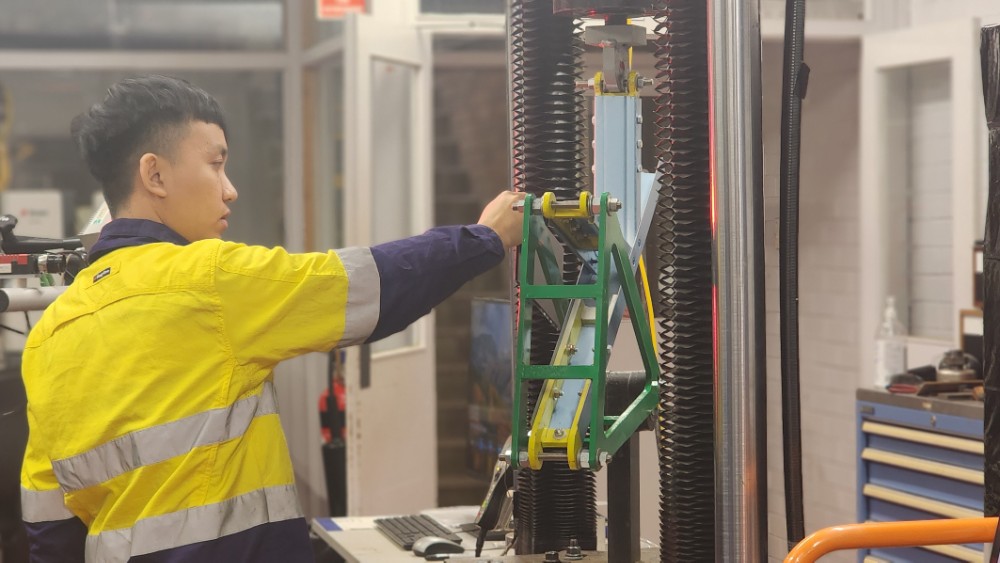
The project team brings together USyd’s Cao Hung Pham, Hoang Vu Le and Ruilin Zhang, together with BSL’s Paul Jones, Mark Eckermann and Trever Clayton. Their combined scientific and technical expertise has allowed the research to progress naturally from component‑level testing to full‑scale experimentation. The project began with around 100 connection tests, which provided essential data on stiffness, strength and failure modes. These early findings guided the next phase of work, including additional testing on screw‑connections in dimple holes behaviour and the capacity of a truss chord between truss webs which are simultaneously in tension and compression, areas that emerged as important as the research unfolded.
As the project matured, the team designed and assembled a full‑scale floor‑joist test rig, enabling them to observe structural behaviour under realistic loading conditions. This transition from small‑scale to full‑scale testing has been seamless, with several successful tests already completed and more underway. The rig now serves as a long‑term capability for both USyd and BSL, supporting ongoing and future research.
The project has also produced a strong stream of publications, including conference papers for ASCCS 2024 in Hong Kong, SEMC 2025 in Cape Town and invited submissions to the Journal of Constructional Steel Research, with several journal papers in preparation. The team has also been invited to contribute to EuroSteel 2026 in Poland, reflecting the international relevance of the work.
Equally important is the renewed relationship between BSL and USyd. Regular presentations have kept BSL closely connected to the research, while a site visit to the university allowed engineers to see the testing firsthand and explore broader opportunities for collaboration. Since the project’s findings are non‑confidential and intended for open dissemination, the work is helping lift capability across the entire steel framing sector and enhance long‑term academic/industry linkages.