
March 18, 2026
Joint Research Sharpens Understanding of Alloy Behaviour in Molten AlZn
The ARC Steel Research Hub project Surface Engineering of Materials for Increased Resilience in AlZn Coating Baths, delivered in partnership with BlueScope, aimed to improve the durability and performance of sink rolls operating in molten AlZn. By combining controlled immersion testing, alloy characterisation and detailed microstructural analysis, the project has generated insights that closely reflect plant‑level behaviours within BlueScope’s galvanizing operations.
This project exemplifies how a coordinated partnership between university researchers and industry specialists can drive meaningful progress on complex materials‑engineering challenges, strengthened by the additional experimental depth provided through Honours‑student involvement.
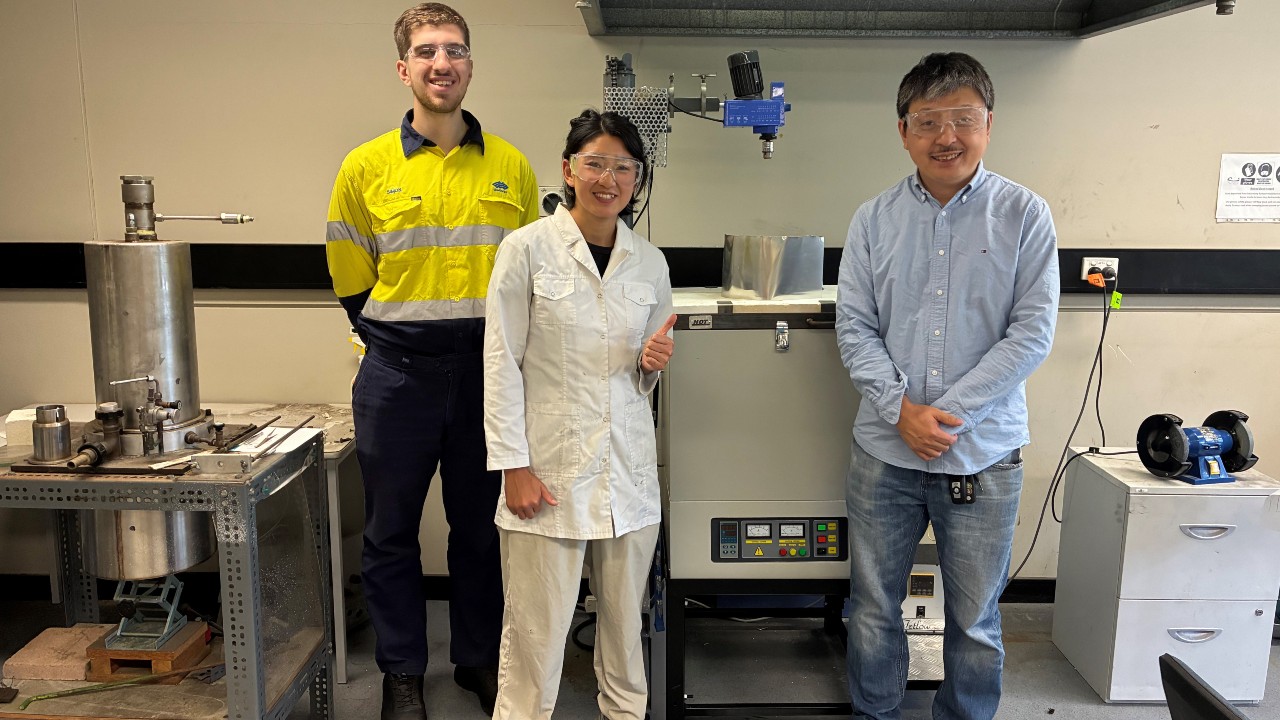
The project teams consist of Associate Professor Yue Zhao (UOW), Senior Professor Huijun Li (UOW), Dr Joe Williams (BlueScope), Dr Nega Setargew (BlueScope), Simon Correnti (BlueScope) and PhD candidate Xialan Liu (UOW).
A distinctive element of the project has been its integration of emerging researchers into the experimental workflow. Over the life of the project, five Honours students worked alongside the research team, providing a consistent and reliable source of hands‑on laboratory capability. Rather than being the centre of the project, their contribution strengthened the team’s capacity to conduct regular immersion trials, refine specialised equipment and progress comparative alloy investigations. Their involvement supported sustained momentum in a research program that required continuous method refinement and repeated experimental cycles.
Additional support came from the PhD researcher, whose microscopy expertise and project continuity helped maintain analytical standards, as well as brief early‑stage participation from a Year 12 high‑school student. Each student with their fresh eyes contributed out-of-the-box thoughts or doubts. These fresh mindsets led to innovative experimental designs and data interpretation, which complemented well with the expertise and skills of the long-term team members. These elements enriched the learning and research environment, but the scientific direction was anchored in the collaboration between the academic team and BlueScope’s industry specialists.
The combined efforts produced a more comprehensive understanding of how candidate alloys behave when exposed to molten AlZn. The project clarified mechanisms of intermetallic formation, dissolution behaviour and interface evolution. These findings, strengthened by laboratory conditions designed to align with BlueScope’s operational environment, confirmed the strong performance of stainless steel and contributed to broader considerations around surface treatments and material selection for coating‑line components.
For the Honours students, participation in an industry‑linked research environment offered meaningful exposure to advanced testing systems and analytical techniques, helping them develop confidence and technical maturity. Their involvement, while not the focus of the project, played a valuable supporting role that enabled the research team to operate more efficiently and with greater experimental continuity.
In summary, this project demonstrates how a well‑structured collaboration between university researchers and industry can accelerate progress on complex engineering challenges. The project’s outcomes reflect the strength of this partnership, supported by the additional capacity provided by the five Honours students who contributed to its experimental depth and sustained research activity.