

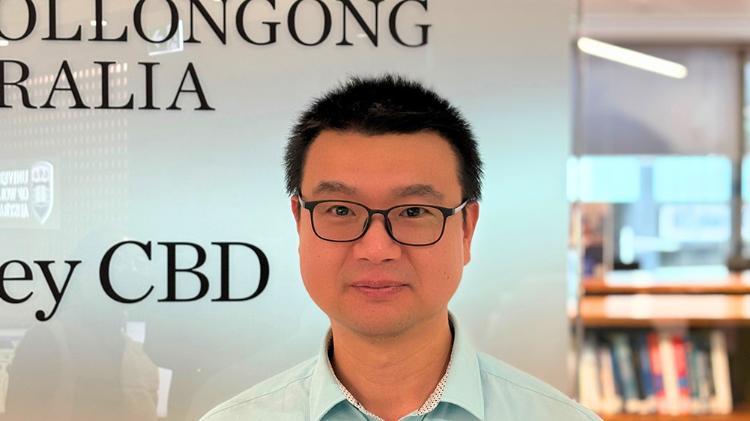
Sydney CBD Campus Librarian, Tony Zhang
Tony introduced us to the facilities and services the university library offers and how students can make the best use of it.
Could you introduce yourself and provide an overview of the student services and workshops you offer?
I'm the Librarian at the Sydney CBD Campus, where I support post-graduate students at the Sydney CBD Campus, UOW. My role focuses on providing tailored library services to enhance students' research and analytical skills. Key services include orientation sessions, business research workshops, citation software guidance, personalised research consultations, 24/7 online learning resources, and interlibrary loans. Our goal is to develop students into informed professionals ready for the modern business world. In essence, our library is not just a service hub - it’s a strategic learning partner, cultivating informed graduates ready to lead in complex, data-intensive business environments.
What steps do you recommend students take to prepare before seeking your assistance?
Preparation is key! I recommend students first review their assignment tasks to clearly identify topics and information types needed, explore resources available via our UOW Library homepage, and then contact us with specific details and preferred times for consultations. Good preparation makes research more effective and productive.
What proactive measures can students take to minimise the likelihood of encountering issues that necessitate your services?
I would advise students to engage early! Attend workshops in Weeks 1-3, access recorded sessions if you can't attend live, and schedule consultations to create a strategic research plan. Being proactive with information is no longer optional - it’s a core competency in modern business and lifelong learning. Strong information literacy reduces stress, enhances time efficiency, and allows students to focus on the insight-generating part of research.
What advice do you give students facing challenges or feeling overwhelmed?
First, manage your time effectively by breaking tasks into smaller, manageable steps using tools like our Assignment Calculator. Next, make use of our quiet study spaces to boost productivity. Lastly, never hesitate to ask for help Academic skills and study support and Book a consultation—seeking support is strategic and smart. Remember, the skills you build now will empower your professional decisions in the future. As the Stoic philosopher Epictetus said, “It’s not what happens to you, but how you react to it that matters.” When students feel lost, we help them find clarity through knowledge.
How can students maximise the value of library resources?
Students can get the most out of library resources by exploring the website early, completing the StartSmart module, and attending orientation and early Trimester workshops. Engaging with the UOW Library guides—especially the Business & Law section—helps build the ability to filter, compare, and apply information effectively. In today’s knowledge-driven world, these skills are key to academic success and future leadership.
Have you come across any surprising or funny questions from students?
Yes. Once a student asked me if I could just give them the three best sources, so they didn’t have to search. It was both amusing and insightful. It reflects the overwhelming nature of information abundance. I used the opportunity to introduce Using, Library SEARCH and show how strategic searching isn’t about shortcuts but about asking the right questions, navigating systems, and thinking critically. That’s what professionals do every day in business: they don’t just consume information; they transform it into decisions.
What’s one book you always recommend?
I always recommend Principles by Ray Dalio for its insights on decision-making and systems thinking. For broader life lessons, The Road Less Travelled by M. Scott Peck offers timeless advice on responsibility, discipline, and personal growth. Both books highlight the balance between structure and creativity—essential for both study and life.
When you’re not surrounded by books, what do you enjoy doing?
I enjoy photography, hiking, and exploring how ancient wisdom and modern knowledge intersect, from philosophy to systems thinking. I believe the best ideas come from crossing domains, and I bring that spirit into my work with students and colleagues every day. Outside the library, I continue to engage in strategic learning and reflective practice because in both business and education, the journey of mastering knowledge never ends.