
Ways to ‘catch the conscience’: the book, the stage, and the moral imagination in Marlowe, Shakespeare, and Middleton and Rowley
Agora Speaker Series: Dr Kate Flaherty
-
-
-
Wollongong Campus
24-203
Abstract
First published in 1632, William Prynne’s Histriomastix proclaims that ‘popular Stage-Playes,’ are ‘most pernicious corruptions; condemned in all ages as intolerable Mischiefs to […] the manners, mindes and soules of men.’ In contrast, three decades earlier, Shakespeare’s Hamlet claimed a special moral agency for the artform—‘the play is the thing in which [he] will catch the conscience of the king.’ In these accounts, plays play opposite moral functions: in one the corrupter, in the other the revealer, of metaphysical truth. Which account provides a more accurate understanding of the role of drama in shaping the moral imagination in the late sixteenth and early seventeenth centuries? In this paper, I argue that the public playhouse established vivid spatial and physical co-ordinates for a moral imagination shared by playwrights, audiences and latter-day critics of theatre. To do so, I examine the dynamics of moral encounter, the dramatized metaphor of the body as book, and the evolving idiom of the ‘book of conscience’ in plays by Marlowe, Shakespeare, and Middleton and Rowley’s The Changeling.
Bio
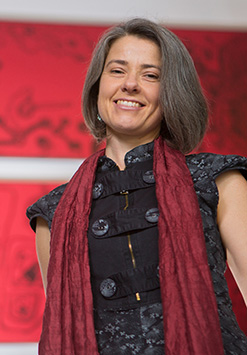
Kate Flaherty is the Head of English and Senior Lecturer in English and Drama at ANU. She researches how Shakespeare’s works play on the stage of public culture. Her sole-authored books are Ellen Terry, Shakespeare and Suffrage in Australia and New Zealand (CUP, 2025), and Ours as We Play it: Australia Plays Shakespeare (UWAP, 2011). Her other scholarship explores aspects of 19th century Shakespeare performance such as touring, education, and gender. She has published chapters and edited volumes of essays for Cambridge, Arden, Palgrave and Routledge; and published articles and reviews in Shakespeare, Renaissance Quarterly, Modern Drama, Shakespeare Survey, New Theatre Quarterly, The Guardian, The Australian Book Review, and The Conversation.
Kate is a Senior Fellow of the Higher Education Academy, and winner of the ANU Vice Chancellor’s Award for Excellence in Education.