
FAQs
The following FAQ guide seeks to provide information drawing from international literature and our own research. This will be updated as new information comes to hand.
- What is offshore wind energy?
- Why offshore wind?
- Why not other forms of renewable energy?
- Why not onshore wind?
- Why the Illawarra?
- What is the process for declaring an Offshore Electricity Infrastructure Zone?
- What is the process for developing an offshore wind farm in Australia?
- How will communities get a say?
- How much power will the wind farms produce and how will it be used?
- Is it still worth pursuing offshore wind if it has negative impacts on marine ecosystems?
- Will I be able to see them from shore?
- Will this negatively impact the price of my property?
- What happens at the end of the life of the turbines?
- Will the turbines be able to cope with big seas or extreme weather?
- Will the farm impact on other users like fisheries, shipping and tourism?
Offshore wind energy refers to the energy that is generated when the force of winds at sea turn large turbines. The rotation of the turbines turns magnets inside a coil of wire, producing electricity. This electricity travels down through cables in the tower to an offshore substation, where a transformer steps up the voltage. High voltage undersea cables then transport the electricity to a land-based substation, where a transformer adjusts the voltage again so that it can be connected into existing transmission grid infrastructure. An offshore wind farm is made up of many turbines in a designated area, connected together to produce energy.
Renewable energy production is vital to address climate change, fulfill Australia's net-zero by 2050 commitments, and ensure energy security. Offshore wind has substantial energy production potential, with a single 100-turbine project capable of generating 1.5-2GW of energy. To put this in perspective, Eraring, Australia's largest coal-fired power station near Lake Macquarie in NSW, produces 2.88GW. Because offshore wind is more consistent than either onshore wind or solar PV (domestic and utility-scale), it is the most practical solution to ensure time-sensitive renewable energy grid security for the National Energy Market. This high capacity, consistent energy source is particularly crucial for Australia's industrial decarbonization efforts. BlueScope Steel, for example, estimates it will need approximately 15 times its current energy consumption to transition to sustainable steelmaking operations in the Illawarra region.
*Access the full report here:
To meet net zero by 2050 obligations and address climate change, it is widely accepted that we need to significantly increase large scale renewable energy generation to replace coal and gas. This ultimately means that we will likely need to develop multiple renewable energy sources to meet different needs - there is no ‘one size fits all’ solution. Capacity factor is a ratio of actual electricity output to maximum theoretical output. As detailed in the table below, offshore wind has the highest capacity factor (45-55%) among all renewable energy options currently under consideration in Australia, surpassing both utility-scale solar (25%) and onshore wind (35%).
With 87% of Australia’s population located within 50kms of the coastline, offshore wind has the capacity to generate substantial electricity while minimising transmission losses associated with long distance power delivery. In essence, investing in large scale renewable energy infrastructure in remote inland regions would entail significant power loss during transmission to densely populated areas, and would require extensive transmission routes.
Input energy source - Capacity Factor Range - Comment
Coal - 65-80% - Newer coal fired generation has a capacity factor of 80%. Australian NEM coal fired generators have declined from 88% capacity factor in 2008 to the current level of 65% in 2023
Gas - 15-30% - Newer gas fired generation has a capacity factor of 30%, noting the mainly ‘peaking’ nature of gas fired generation. Australian NEM gas fired generators have declined from 27% capacity factor in 2011 to the current level of 16% in 2023
Solar (no battery) - 10-25% - Capacity factor is determined by the diurnal window
On shore wind - 30-35% - Onshore wind resources are highly variable and subject to becalmed conditions
Offshore wind - 45-55% - Offshore wind resources are substantially less prone to becalmed conditions than onshore wind resources
Both onshore and offshore wind play an important role in the transition to renewable energy and away from carbon-based industries (such as coal, oil, and gas). The difference between the two options is the size and scale of the infrastructure and how the electricity is then transmitted. While onshore wind has many advantages (it is far cheaper, quicker and easier) wind on land is not as consistent, which means there is not consistent energy generation. Onshore wind also has a smaller capacity of electricity generation. Offshore wind on the other hand is considered to be more efficient, as the wind speeds are higher and more consistent and because offshore wind farms are located off the coast they are located further from people who live in the surrounding areas.
*Access the full report here:
Regions are generally chosen as sites for offshore wind because of resource availability, existing infrastructure and proximity to demand. In the case of the Illawarra there is strong and consistent wind off the coast, which ensures more reliable electricity generation. There is existing infrastructure in the form of a deep-water industrial port (Port Kembla), existing transmission infrastructure, and the existing steelworks as well as a skilled manufacturing workforce. The proposed Offshore Electricity Infrastructure Zone is also close to areas of high energy need.
The development of offshore renewable energy in Australia’s waters, including offshore wind, is governed primarily by the Offshore Electricity Infrastructure Act 2021, which empowers the Minister to declare specified areas for offshore renewable energy infrastructure. These areas are described in the relevant legislative instruments as ‘Offshore Electricity Infrastructure Zones’. Before declaring an Offshore Electricity Infrastructure Zone, the Minister must invite submissions from the public about the proposed area of the Zone. In considering whether to declare a proposed area to be an Offshore Electricity Infrastructure Zone, the Minister must have regard to: the potential impacts of the infrastructure on other marine users and interests; any submissions received from the public about the proposal to declare the area; any advice provided by the Defence Minister and the Minister responsible for administering the Navigation Act 2012 (Cth); and Australia’s international obligations in relation to the area.
In 2023, the Illawarra was proposed for declaration as an Offshore Electricity Infrastructure Zone. Following the public consultation period, in late 2023, if the Illawarra offshore area is declared as an Offshore Electricity Infrastructure Zone under the Offshore Electricity Infrastructure Act 2021 the Government will then enter a feasibility licence stage. At this point, the Government will receive and review applications from developers who have an interest in building windfarms in the Illawarra Offshore Electricity Infrastructure Zone.
The Government’s Offshore Energy Regulator released the following diagram for offshore energy renewable projects. Note that it is likely that construction will not begin for approximately 7-10 years.
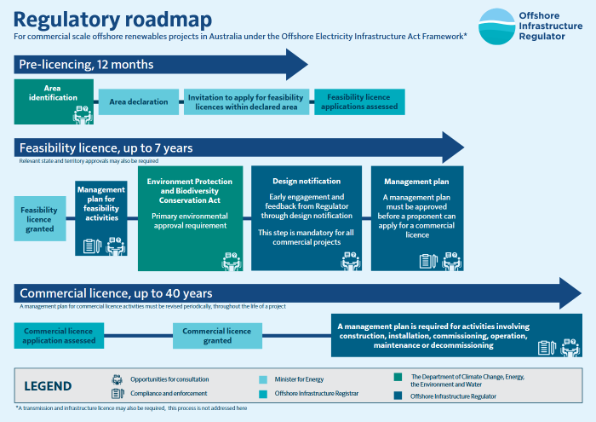
Members of the community were invited to put forward a submission in relation to the proposed declaration of the Illawarra Offshore Electricity Infrastructure Zone. This was our first opportunity to have our say on the declaration of this Zone. In the diagram above, further opportunities for consultation are indicated throughout each stage of the offshore renewable project regulatory roadmap.
The current area of consideration at the beginning of consultation is 1,461 km2. This area would have the capacity to generate up to 4.2 Gigawatts of electricity, which is enough to power 3.4 million homes. If all of the proposed projects in Australia went ahead, combined they would produce more electricity than all of Australia’s coal fired power stations.
The electricity generated by the wind farms will be connected to the National Electricity Market (NEM), which is a wholesale market through which generators and retailers trade electricity in Australia. The NEM interconnects the six eastern and southern states and territories and delivers around 80% of all electricity consumption in Australia. The NEM facilitates the exchange of electricity between generators and retailers. Retailers resell the electricity to businesses and households. High voltage transmission lines transport the electricity from the generators to electricity distributors, who deliver it to homes and businesses on lower voltage ‘poles and wires’.
The wholesale market is where generators such as the proposed wind farms sell Electricity and retailers buy it to on-sell to consumers, such as households. The wholesale market operates around a common pool, or spot market, for wholesale trading in physical electricity. This process determines an electricity spot price which reflects physical supply and demand across the NEM. This spot price is an important price signal for investors.
Financial markets sit alongside the wholesale market and involve retailers and generators entering into contracts to buy and sell electricity at an agreed price. The financial markets enable retailers to manage the risk of volatile wholesale prices for their customers.
Through the wholesale market and the financial markets, the renewable energy generated by offshore wind farms will be made available across the NEM, including within the Illawarra.
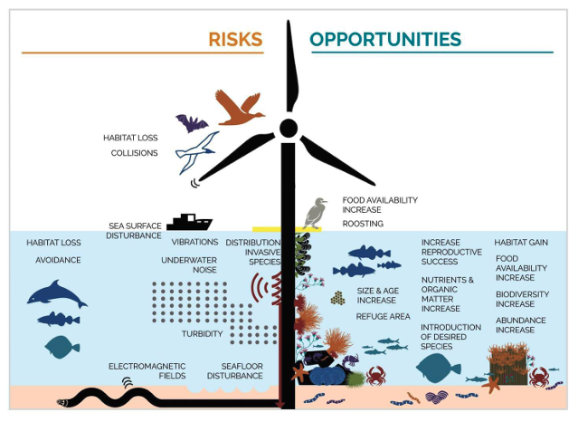
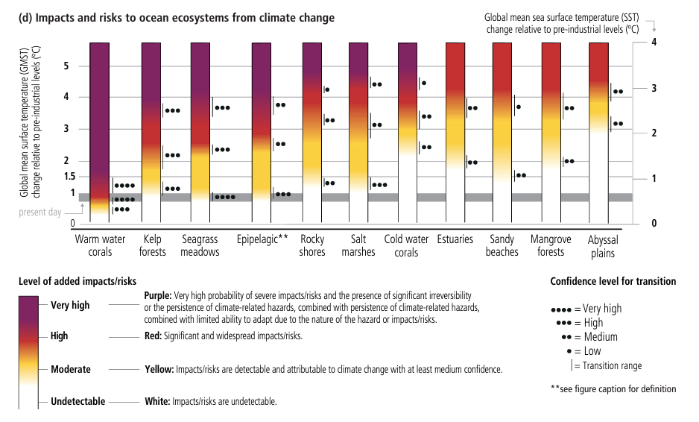
Given that we know there will be some negative impacts on marine ecosystems due to the installation of offshore wind, it is also important to put this in perspective with the negative impacts caused to marine ecosystems due to inaction on climate change. The Ocean Conservancy, for example, supports the development of offshore energy, stating ‘climate change poses the single biggest threat to our ocean and to the future of the planet. Every tool and solution is needed as we work to address the climate crisis. Sustainable ocean-based solutions, particularly offshore renewable energy, play a crucial role’. Finding mechanisms to minimise the negative impacts of offshore wind developments should be prioritised, rather than rejecting offshore wind on environmental grounds, as the cost of inaction is worse than the cost of action.
As offshore wind uses large scale infrastructure it is likely that there will be some visual impact from offshore wind farms. At night, navigation requirements mean some form of lighting will need to be mounted on the turbines. However, the extent that the turbines will be visible from shore will come down to a range of factors. Each individual developer is likely to put forward a different license application, so at this stage we do not know the specifics of the projects in the Illawarra. The size of the turbines, the distance from the shore, the time of day, the distance from sea level you are on land, can all change the visibility of the turbines.
Examples from elsewhere, along with visualisations and simulations can help us to get an idea of what these might look like from the shore. But when looking at simulations it is important to remember that there will be differences in atmospheric conditions day to day that will impact the visibility of the turbines - on cloudy and hazy days for example, you may not be able to see them at all.
Existing examples from overseas have shown that communities adjacent to offshore wind development proposals have been concerned about a loss of property value as a result of a loss of pristine ocean views. Recent research from the USA concluded ‘we find no evidence of negative impacts to property values’ from offshore wind development. A similar study in Denmark found that there was no significant effect of having an off-shore wind farm in view from a property itself or from the nearest beach.
The challenges of decommissioning the offshore energy platforms is an area that is required to be considered by the each developer as part of the licensing arrangements. Developers must provide a clear plan and financial security set aside for decommissioning, before they are granted a commercial license. The majority of components of offshore wind infrastructure are able to be recycled. For example, steel from marine structures is commonly re-smelted for revenue, while reinforced concrete can be repurposed as aggregate or for coastal defence purposes. Composite turbine blade recycling options is more challenging but advances are currently being made for options for reuse, repurposing and recycling.
Wind provides an excellent option to reduce overall emissions, with comprehensive life cycle assessments indicating that compared to coal power stations, wind turbines have significantly lower life-cycle GHG emission intensities. Despite this more work is required to minimise greenhouse gas emissions associated with offshore wind construction and maintenance.
The technical specifications of the turbines will vary in each application. As part of their feasibility license application each developer will have to demonstrate their strategy for ensuring the resilience of the proposed turbines and associated infrastructure. To combat the obstacle of storms and strong winds both offshore and onshore turbines are likely fitted with in-built technologies to minimse the impact of wind on the turbine. For example, by reducing the surface area that is pointing into the wind when the wind exceeds a certain speed.
It is likely there will be some impact on other ocean users as there will be exclusion zones around the wind farms that will limit access and specific uses in certain areas. For example, trawl fisheries may be restricted in certain areas.
Impacts on commercial fishing
The primary source of impact on the fishing industry would be via exclusion of fishing activities. Depending on the location of the wind farms the Commonwealth and State trawl and trap/line sectors could be impacted. The impacts of these exclusions on fisheries is an area UOW have highlighted as an important consideration for both Government and developers as they develop their plans for the proposed zone. In particular there is scope to explore multi-use models of management that are currently being investigated in Europe.
Impacts on shipping
Shipping may be impacted by the development of offshore wind farms off the coast of the Illawarra. For example, ships may have to alter their navigational routes, wind turbines may pose a navigational risk (often mitigated by night time safety lighting), there may be disruption to communication and to anchorage and mooring for ships. However, the development of offshore wind may also have a positive economic impact on the shipping industry as a result of increased port activity as a result of the construction and maintenance of wind farms and their associated infrastructure. Further information on how negative impacts to shipping can be mitigated and what needs to be considered, is outlined by the UK Government in relation to the development of Offshore Renewable Energy Infrastructure in the United Kingdom.
Impacts on tourism
Certain examples from overseas show that there is opportunity for co-existence between offshore wind and certain other users, such as the tourism industry. For example. Sussex Boat Trips in the South East of England actually offers boat tours to the Rampion Offshore Windfarm. Examples, such as this, suggest that it doesn’t have to be an ‘either-or’ situation when it comes to offshore wind and other industries. There is potential for multiple uses. Furthermore, as much of the local marine tourism in the Illawarra (such as scuba diving, or whale watching) would likely occur within 10km from the shore, the direct impacts on tourism are likely to be minimal. Yet, potential conflicts amongst marine users should be addressed by individual developers and the Government throughout consultation periods.