

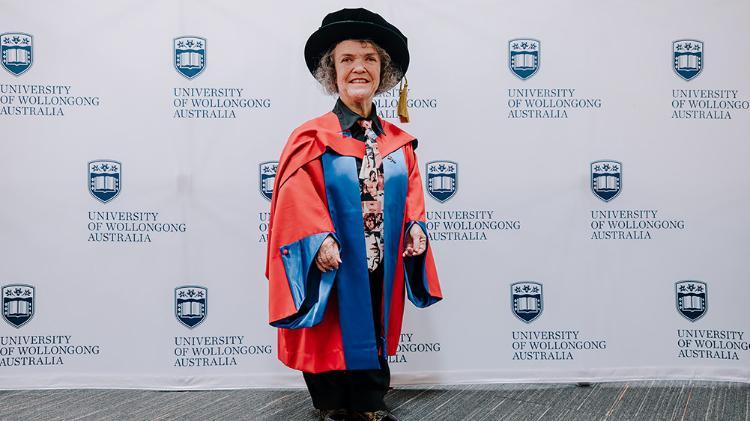
Honorary Doctor of Letters
Citation delivered by Professor Peter Kelly at the University of Wollongong on the occasion of the admission of Debra Keenahan as a Doctor of Letters (honoris causa) on 16 July 2025
Deputy Chancellor, I present to you Dr Debra Keenahan.
Art at its most powerful does more than reflect the world – it compels us to see it through the eyes of others, to question our assumptions, and to reimagine how we understand difference. Throughout her diverse career, Dr Debra Keenahan has used her scholarship, creativity, and lived experience as a woman with achondroplasia to reshape how society perceives disability and affirms human dignity.
Born in Wollongong in 1962, one of Dr Keenahan's earliest memories is of being judged at age four for her dwarfism, a foundational experience that became the catalyst for a lifetime dedicated to understanding and challenging prejudice. A pivotal moment came at the age of eight when she experienced South Africa at the height of apartheid and another as a teenager when, witnessing racism at a cricket match, she recognised how easily society can condition people to strip others of their humanity. This realisation cemented her decision to study psychology, and through it, understand the forces that compel people to treat others as “less than” human.
Dr Keenahan earned her first PhD from the University of Wollongong in 1990, examining the concept of dehumanisation and its impact on marginalised groups. Her groundbreaking research, conducted jointly with Oxford University, earned her the NSW Queen Elizabeth II Silver Jubilee Trust Award for Young Australians in 1987. For over two decades, she worked as a psychologist, initially within Corrective Services, and then shared her expertise as an educator at Central Queensland University, Griffith University, and Western Sydney University, teaching subjects on inequality and human rights from a social psychology perspective.
In 2011, a transformative moment arrived when Dr Keenahan reconnected with art through a community college class. She discovered art’s powerful capacity for connection, launching her into a multidisciplinary practice through which she found new ways to challenge society’s perceptions of disability and amplify voices too often left unheard.
Through her expansive artistic practice, Dr Keenahan invites audiences to experience the world through her eyes. Her breakthrough work, the sculpture "Little Big Woman: Condescension," explored the experience of being a person with dwarfism, confronting the condescending attitudes often faced in public that Debra knows intimately. From virtual reality installations to theatre works and short films, her art showcases the impacts of othering in ways that are uniquely creative, compelling and confronting.
Beyond her artistic innovations, Dr Keenahan has been a fearless advocate for inclusion and human dignity. Her testimony to the 2022 Disability Royal Commission detailed sixty years of harassment and discrimination, transforming personal pain into powerful advocacy for change. Debra has used her appearances at writers’ festivals, conferences, on television and in podcasts to raise awareness of the personal and social impacts of society’s attitudes toward disability, and the glorious possibilities afforded by difference.
Dr Keenahan’s journey reflects her conviction that art and scholarship can transform how we see one another. She has turned personal experiences of prejudice into creative works that build empathy and understanding, challenging assumptions about disability and difference. Her life’s work reminds us that a truly inclusive society – one that embraces rather than excludes, and celebrates rather than stigmatises – recognises the dignity inherent in every person.
Deputy Chancellor, it is a privilege to present Dr Debra Keenahan for admission to the degree of Doctor of Letters, honoris causa.