

December 1, 2025
Combating Precipitate Coarsening to Strengthen Next-Generation HSLA Steel
Researchers from the ARC Steel Research Hub (Professor Elena Pereloma, PhD student Ali Baqeri from UOW) together with BlueScope’s Chris Killmore, are advancing the understanding of how processing conditions influence the strength of next-generation high-strength low-alloy (HSLA) steels. These steels are essential for modern construction, transport and manufacturing industries where superior strength, toughness and cost efficiency are critical.
The team designed and studied two novel steel compositions containing controlled additions of chromium (Cr), vanadium (V) and niobium (Nb), elements that provide a cost-effective alternative to traditional titanium–molybdenum (Ti, Mo) HSLA systems. In this design, Cr plays a similar role to Mo, promoting the precipitation of nanoscale carbonitrides and improving resistance to coarsening during thermal exposure. The Cr–V–Nb combination offers comparable strengthening efficiency while maintaining economic advantages in alloy cost. The ultimate goal of this development is to achieve a strength of 800 MPa while ensuring good toughness and processability.
During strip production, variations in finishing deformation temperature, coiling temperature and coiling time strongly affect the formation and evolution of nanoscale (Cr,V,Nb)CN precipitates. These precipitates appear as both interphase and random within the microstructure. Their size and stability are key determinants of mechanical strength — fine and uniformly distributed precipitates lead to greater precipitation strengthening, while coarsening results in strength loss.
Using laboratory simulations and industrially relevant thermal schedules, the team is mapping how processing variables control precipitate number density, size and distribution. Through this, they aim to identify conditions that maintain a dense population of fine, nanoscale precipitates even during prolonged coiling or thermal exposure.
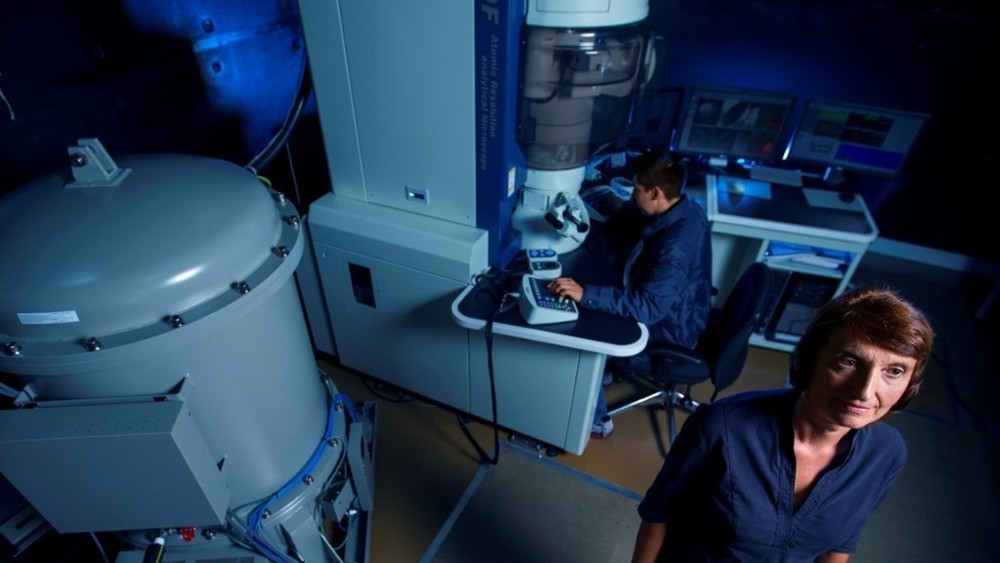
Advanced facilities such as the Gleeble thermo-mechanical simulator and high-resolution transmission electron microscope (HRTEM) are central to the work. The Gleeble allows easy variation of parameters, while HRTEM reveals the nanoscale precipitation mechanisms that underpin strengthening. Together, these tools uncover a direct link between thermomechanical processing, precipitate evolution and macroscopic strength.
This study highlighted the interplay between coiling time and temperature, diffusion rates and interactions of alloying elements, and precipitation kinetics leading to the formation of Cr-rich shell and V-rich core in these multi-component precipitates which are responsible for restriction of coarsening.
Through this collaborative research, Professor Pereloma’s team contributes to the ARC Steel Research Hub’s mission of delivering innovative, sustainable and high-performance steel solutions for BlueScope and ultimately, its Australian customers.