

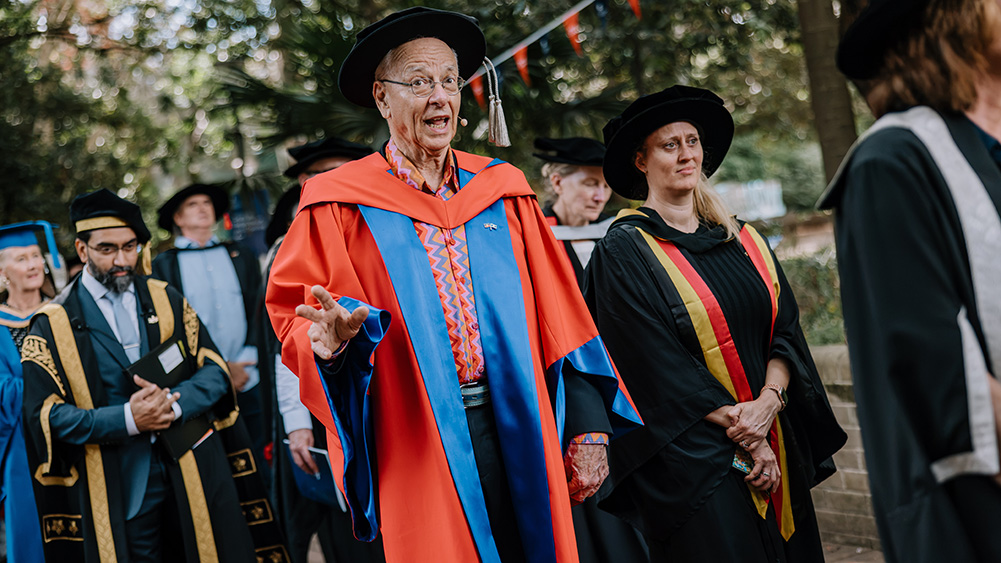
Honorary Doctor of Science
Citation delivered by Professor Alan Rowan at the University of Wollongong on the occasion of the admission of Karl Sven Kruszelnicki as a Doctor of Science (honoris causa) on 4 November 2026.
Deputy Chancellor, I present to you Dr Karl Kruszelnicki AM.
For more than four decades, Dr Karl, as he is widely known, has brought science out of the laboratory and into the lounge room, the family car and the everyday conversations of Australians. Whether on radio, television, in books, on stage or online, he has made difficult ideas feel inviting, useful and, very often, fun.
Dr Karl’s story begins in Sweden before moving to Wollongong at the age of two, where he grew up, attended local schools, and studied physics and mathematics at the Wollongong campus when it was part of the University of New South Wales. From there, his career took a route no careers adviser could have mapped.
He worked as a physicist at the Port Kembla Steelworks. He researched hair and wool in Papua New Guinea. He made films, repaired cars, drove taxis, presented the weather on TV, spent a quarter-of-a-century test-driving 4WDs in the Australian Outback and has crossed 15 of Australia’s 17 deserts, helped build Australia’s first two-way audio-and-video network in 1972 at the Aquarius Arts Festival, and was a ‘roadie’ for various musicians including Slim Dusty and Bo Diddley.
But rather than taking him away from science, these unconventional careers gave him more ways to understand science and bring it to life for others.
Dr Karl learned how machines behave, how to present ideas, and how a good story can turn a complicated concept into something simple.
He later studied biomedical engineering and medicine, designed and built an instrument to detect electrical signals from the human retina for Fred Hollows, worked in hospital cardiology as a Scientific Officer, and practised as a doctor in adult and children’s hospitals. Together, these experiences gave him a rare breadth of scientific knowledge and practical insight, and an ability to communicate complex ideas in ways that were clear and engaging.
In 1981, that ability found its audience. Through his long association with ABC radio, Dr Karl became the person Australians could ask about almost anything. From the human body and the natural world to space, technology and every random question in between, Dr Karl had an answer.
For generations of Triple J listeners, he became a familiar voice and a licence to be curious. Through Great Moments in Science, his question-and-answer programs, television appearances on programs including Quantum and Good Morning Australia, and later through books, podcasts and digital media, he has carried scientific conversation across generations and into almost every corner of Australian life. Currently, he does Science Q&A to a dozen radio stations and schools each week.
The honours presented to Dr Karl are almost as varied as his career. He has been appointed a Member of the Order of Australia, awarded the Centenary Medal, named a National Living Treasure and recognised as the 2025 NSW Senior Australian of the Year. He was also the first Australian to receive UNESCO’s Kalinga Prize for the Popularisation of Science. His more unusual distinctions include an Ig Nobel Prize for his investigation of belly-button lint and an asteroid, 18412 Kruszelnicki, named in his honour.
Dr Karl has made curiosity contagious. He has helped people who might never call themselves a scientist to think again, ask why, and enjoy the feeling of finding things out.
Deputy Chancellor, it is a privilege to present Dr Karl for admission by the University of Wollongong to the degree of Doctor of Science, honoris causa.