

How UOW researchers and industry are advancing manufacturing in the Illawarra
National Science Week 2026
September 10, 2026
From clean energy and batteries to medical devices and biomanufactoring, researchers are working with industry to advance manufacturing in the Illawarra.
University of Wollongong (UOW) researchers are working with industry to advance manufacturing in the Illawarra, developing new technologies in clean energy, batteries, advanced materials, medical devices and biomanufacturing.
For nearly a century, the Illawarra’s identity has been forged in steel, heavy industry, and manufacturing. Since the establishment of the Port Kembla Steelworks in 1928, the region has powered through generations of industrial evolution, thriving on continuous innovation, from world-first developments to breakthroughs in metals and materials.
Today, as global economies shift toward decarbonisation, sovereign capability, and high-tech healthcare, world-class discovery science and collaboration is driving new manufacturing industries in the Illawarra.
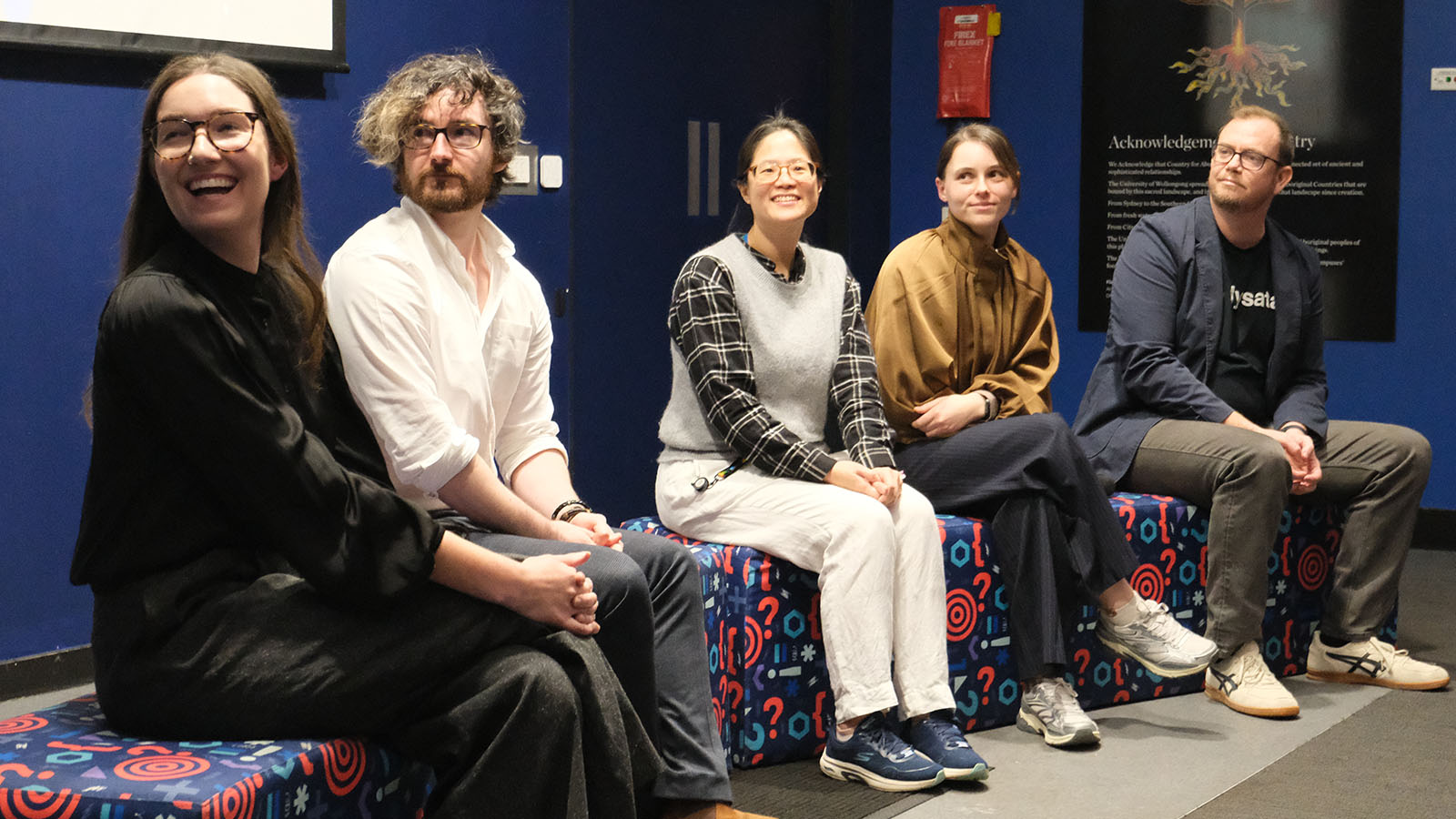
At a showcase organised by the Distinguished Professors Alliance (DPA) at UOW, five early-to-mid career researchers (EMCR) presented ground-breaking technologies that prove Australia’s manufacturing future won't just depend on heavy machinery, but on the scientific discoveries happening today at UOW and industry collaboration.
Green hydrogen and next-gen energy storage
For over 200 years, scientists have known how to split water into hydrogen and oxygen. The challenge has always been efficiency, cost, and scale. Dr Aaron Hodges, a UOW alumnus and Senior Manager at clean-tech spinout Hysata, highlighted how a discovery made at UOW’s Innovation Campus is revolutionising the global energy transition.
"Our journey started with a one square centimetre cell on a laboratory bench here on the Innovation Campus. We progressed to the commercial version of our cell, and now we have stacks of cells that contain thousands of them," Dr Hodges shared.
By eliminating energy-wasting gas bubbles on electrodes, Hysata developed a capillary-fed electrolyser achieving a world-beating 95% system efficiency.
Backed by $111 million in Series B funding, Hysata operates today out of a manufacturing facility in Port Kembla, employing 120 experts. Following successful trials in Saudi Arabia and their first commercial order, Hysata is scaling up toward gigawatt-capacity plants.
"Our first cell was an invention; the millionth one is an industry.”
Down the road, another UOW-linked success story is tackling the world’s battery bottleneck. Dr Jamie Smyth, Research Manager at Sicona Battery Technologies, presented SiCx – a silicon-carbon composite designed to replace traditional graphite in lithium-ion batteries.
Because silicon can hold up to 10 times more energy than graphite, it offers significant improvements in EV driving range and fast-charging capabilities. Sicona’s hard-carbon layer controls silicon’s expansion, resulting in an electrode with five times the energy capacity of traditional graphite.
With a $45 million federal grant secured to establish a commercial demonstration plant in Port Kembla, Sicona is rapidly expanding its workforce.
"Everything we do is to empower the wider community towards a sustainable energy future without costing the Earth," Dr Smyth emphasised, noting the potential to build sovereign battery supply chains here in Wollongong.
Advanced materials and space-grade sensors
Advanced manufacturing also requires re-imagining fundamental materials. UOW researcher Shirley Yang presented her work on metal matrix composites reinforced with graphene – a single-atomic layer of carbon derived from graphite.
By weaving graphene into aluminium and magnesium alloys, Yang is creating lighter, stronger, and more wear-resistant composite materials. As automotive industries aim to reduce vehicle curb weights by 40% to hit 2050 sustainability targets, graphene-enhanced composites could transform engine components, aerospace engineering, and defence manufacturing.
"By leveraging local strengths, research from UOW and local industry like BlueScope, we can generate a stronger manufacturing future," Yang explained.
In the medical and aerospace realms, UOW Associate Research Fellow Dr Jessie Posar is pioneering flexible, printable radiation sensors. Traditional radiation detectors are rigid, expensive, and manufactured overseas. Dr Posar’s solution uses solution-processable inks that can be printed on flexible substrates at speeds of up to 100 metres per minute using roll-to-roll printing.
Because these printable sensors match human tissue properties, they can be worn as skin patches during cancer treatments to monitor exact radiation dosages at facilities like the Illawarra Cancer Care Centre. Furthermore, because the materials are lightweight and resilient, they are being adapted for solar cells and radiation monitoring in space applications through funding from Australia’s Office of National Intelligence.
A bioengineering hub for first-in-human trials
Perhaps one of the most transformative opportunities emerging is bioengineered healthcare. Dr Anna Kulaga, a UOW Associate Research Fellow presented BIENCO, a national consortium developing bioengineered corneas.
Corneal blindness affects millions worldwide, yet treatments are limited by a severe shortage of donor tissue. By assembling human collagen molecules in electric fields and integrating specific cell types, BIENCO creates transparent, structurally sound tissue tailored for transplantation.
To bridge the gap between benchtop discoveries and clinical patient treatment, UOW is leading the establishment of the Biomanufacturing Initiative for Clinical Entry & Production (BICEP). This proposed pilot-scale Good Manufacturing Practice (GMP) facility will be the first of its kind in Australia, enabling first-in-human (FIH) trials for 3D-bioprinted corneas, wound-healing skin tissues, and bone and cartilage regeneration products.
"Our vision is to create a platform to bridge the gap between research discoveries and actual clinical deployment," Dr Kulaga explained.
The role of early-career researchers
Translating research from a lab to an industrial scale requires moving past standard academic boundaries. As panel discussions revealed, the shift from pure discovery science to commercial manufacturing requires learning automation, establishing rigid standard operating procedures, and managing real-world deadlines.
For Wollongong, the impact of this transition is clear. From Sicona and Hysata to future biomanufacturing facilities, emerging tech is building pathways for more engineers, technicians, scientists, and analysts in the Illawarra. UOW students also gain direct access to industry-led translation, upskilling opportunities, and advanced manufacturing platforms not found anywhere else in Australia. By manufacturing high-tech sensors, battery components, clean hydrogen cells, and medical devices domestically, Australia builds resilience against global supply chain vulnerabilities.
Distinguished Professor Gordon Wallace explained that collaboration in the Illawarra is proving that the manufacturing hub of tomorrow is built on the scientific breakthroughs of today.
"Manufacturing opportunities begin with innovative science and engineering... and manufacturing survives by continuing to innovate as it goes along, which requires us to build a highly skilled workforce in parallel."