

Mapping a SAEF future in science
PhD researcher Cassie Newman takes on any adventure that comes her way.
February 11, 2026
A love of nature has pushed Cassie Newman to embrace even the most unexpected opportunities, taking her from the beachside outer suburbs of Auckland to the sub-Antarctic islands, the University of Wollongong and, hopefully one day, Antarctica.
In high school, Cassie Newman didn’t think she was smart enough to be a scientist. Now, she has degrees in marine biology and geospatial science and is part of a leading interdisciplinary research program as she works towards her PhD at the University of Wollongong (UOW).
The great outdoors and the great unknown
Growing up in New Zealand, Cassie loved being outdoors. She didn’t know where her career was heading, but she knew she wanted to do something where she could be outside in nature. She was in scouts and did lots of camping and hiking, even volunteering and taking internships as a park ranger.
Those experiences made her realise she wanted to learn more about how the world works and how everything fits together.
“I didn't think I was smart enough to be a scientist when I was in high school,” says Cassie. “I didn’t study at all, and I ended up failing biology and physics in my final year.”
It was at an open day at Auckland University of Technology that she first heard about geospatial science from Professor Barbara Bollard – who is now Cassie’s PhD supervisor at UOW.
“Professor Bollard said marine biology and geospatial science is the way to go. Hearing about her work with endangered Maui dolphins, I was convinced and I thought, I’ll do that.”
“When I actually got to university, my passion for science really started to grow,” Cassie continues. “What we were learning was so much more interesting than what I’d done in school.
“I had no idea what geospatial science was when I got into it, yet it’s been what I’ve pursued through my bachelor’s and master’s degrees. It’s mapping and analyses of spatial data, and I like that it’s kind of a really creative way to communicate data.”
A cruise in the sub-Antarctic and a jump across the Tasman
Along with a love of the outdoors, Cassie has always had an interest in exploration and in the sub-Antarctic and Antarctica, as well as what can be learned from the region and applied to how we interact with the environment.
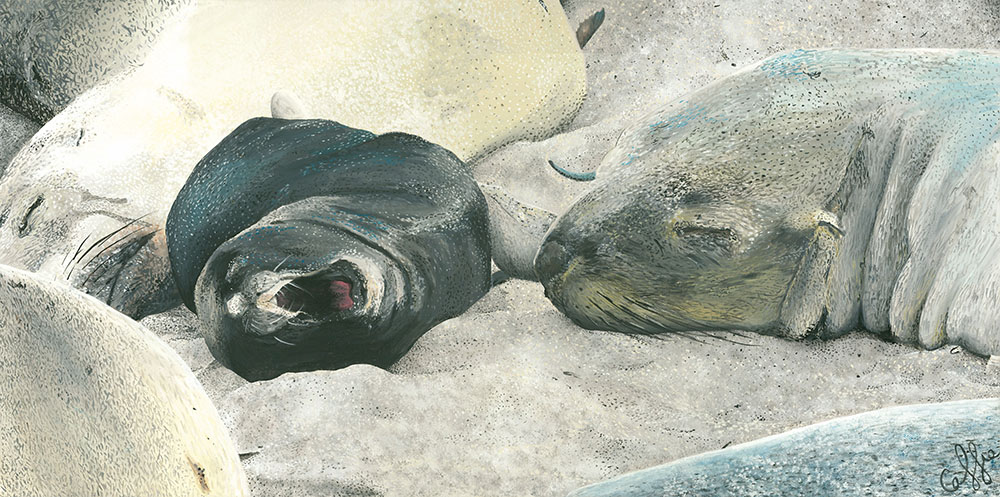
In 2022, she applied for a True Young Explorer Scholarship with Heritage Expeditions and was able to travel on a tour around the New Zealand sub-Antarctic islands. “It was an awesome trip,” she says. “Just seeing the wildlife and the plants and learning about the environment. It was breeding season for the sea lions, so we saw lots of babies, and even saw a sea lion give birth.”
After the 12-day cruise, Cassie put her creativity to use as a True Young Explorer ambassador by painting a series of artworks, selling the prints and donating the profits to different charities that support nature in New Zealand.
During this time, she was working as an engineering analyst at the Otago Regional Council on New Zealand’s South Island, conducting geospatial analysis and flood modelling relating to rivers.
While she really enjoyed the work, by 2024 Cassie was eager for more opportunities for growth and preoccupied with her ongoing interest in the Antarctic.
“Professor Bollard posted on LinkedIn about a post-doctorate opportunity at UOW that included hydrological modelling, remote sensing and Antarctic research,” she recalls. “It was everything I wanted to do with my career, but I didn’t have a doctorate. I reached out and was able to secure a PhD scholarship position. So, I made the jump across the Tasman in 2024.”
Most of the planet’s fresh water is locked in ice
After starting out in marine biology, then flood modelling, Cassie now turns to water availability in the world’s biggest desert.
“I'm determining the influence of water availability for photosynthetic life in Antarctica using remote sensing and hydrological modelling.”
While it might seem strange, Cassie explains that although Antarctica contains most of the planet’s fresh water, it is locked in the ice, meaning there is a scarcity of water available to plant life on the continent.
“Water is only biologically available for a small time of the year,” she says. “It varies a lot through different seasons. Some years there’s a warming event and lots more melt. Usually, ice will melt slowly throughout the summer season, allowing plant life lots of time to photosynthesise and grow. But when it melts faster and earlier in the season, by January and February when it’s a lot warmer and there’s less snow, they are more susceptible to sun damage and wind exposure, making the plants more stressed.
“With different climatic factors occurring, my aim is to understand how water influences the distribution, health and resilience of photosynthetic life, including how patterns may change over time and how nutrients play a role.”
Reviewing existing research, Cassie notes spatial gaps all over Antarctica where there isn’t data about this topic, largely due to logistical constraints, with studies mostly focused on accessible photosynthetic life around research stations.
Through her work, Cassie hopes to create a standard methodology that can be used throughout Antarctica, regardless of geographical constraints, to determine how water availability is changing and how it influences photosynthetic life.
Remote multispectral and hyperspectral sensors will enable Cassie to see changes in drone imagery that can’t be seen by the human eye. She explains that multispectral sensors use multiple bands of light, such as infrareds, allowing you to see chlorophyll and water with a lot more brightness. Similarly, hyperspectral can be used to identify specific species.
Empowering experiences
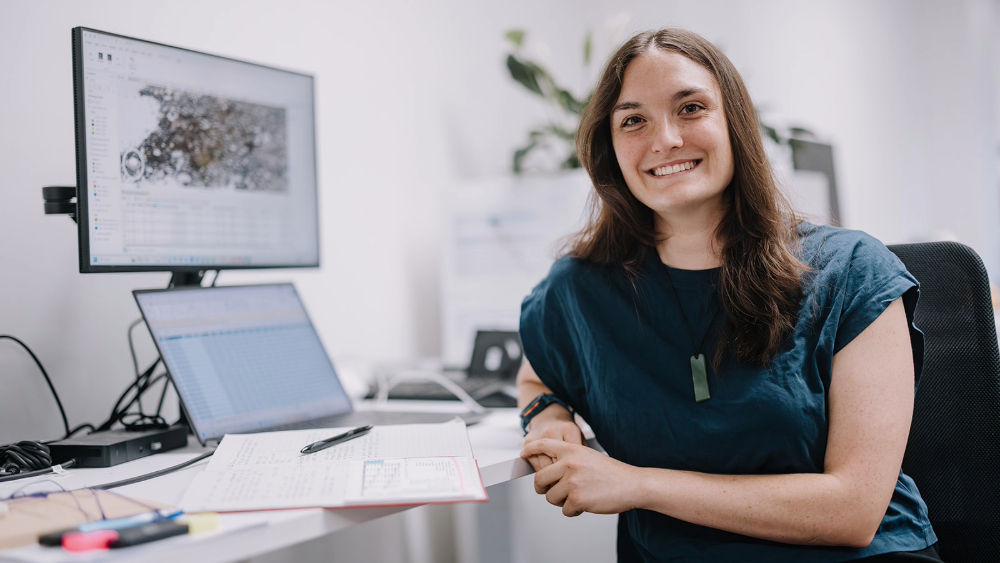
While she dives into this technically complex work, Cassie is supported and empowered by her research group at UOW – the University’s Securing Antarctica’s Environmental Future (SAEF) team.
Her scholarship was funded by SAEF, an Australian Research Council Special Research Initiative that brings together leading interdisciplinary scientists, with the goal to protect Antarctica and in turn, protect the future of the rest of the world.
On International Day of Women and Girls in Science (11 February), Cassie reflects on what it means to work in a research group with so many leading scientists, such as Professor Bollard and Distinguished Professor Sharon Robinson AO.
“I think it makes a difference to how accessible a research career feels,” she says, adding that two of her three supervisors are women and there are many more throughout the wider team. “It is a safe place to grow and there’s no single model of success.”
As someone who once didn’t think she was smart enough to be a scientist, Cassie says she still feels a bit of imposter syndrome but has come to realise that everyone feels that way during their PhD. “The team makes me feel like I can lead and succeed in science.”
As well as the everyday mentorship she receives from her team, Cassie has embraced more formal opportunities for development, participating in the LIFT program in 2025, a UOW and iAccelerate collaboration which empowers women in STEM to be leaders. Following a leadership retreat and entrepreneurship course with iAccelerate, she completed a three-month internship with Geoscience Australia, the national geoscience organisation.
“They already had a tool that pulled satellite imagery of wetlands from the last 40 years and classified them based on water and vegetation,” says Cassie. “My job was to create a program that would flag where there was a sudden change and show the before and after of the wetlands. It was really interesting and I’ll definitely use what I learned about change detection in my PhD.
Cassie credits the team at Geoscience Australia and the chance to work on a real-world challenge with helping her learn Python coding during her internship, a type of coding she had always struggled with in the past.
When asked if she has any advice for young women and girls interested in a career in science, Cassie recalls how challenging it was to learn complex coding. “What’s really helped me is telling myself that my future self is going to thank me and is going to be grateful that I’ve put in the effort.”