

Making the invisible visible
Abby Kempe on leadership, equity and Australia’s fair go.
March 8, 2026
UOW graduate Abby Kempe is using her roles with Tradeswomen Australia and HerSpace to advocate for women in trades and shine a light on modern slavery and exploitation in Australia.
Content Warning: This article discusses themes of modern slavery, including coercion, abuse, and exploitation. Some content may be distressing to readers.
When Abby Kempe finished her MBA, she wasn’t looking for rest. She was trying to figure out what’s next.
“I had some fire left in the tank. I thought, where am I going to put the additional mental energy? I wanted to make it meaningful,” Abby says.
No one would criticise her for wanting to take a break, with her already booming career at Tradeswomen Australia as the National Lead in Workplace Equity. On any given day, you might find Abby hopping on a plane to run psychosocial safety workshops, speaking on a podcasts about the difference between pressure and harm, or writing industry pieces on retention. Abby developed the Organisational Needs Pyramid, first referenced in the AMWU Women’s Voices from the Floor report, which frames psychosocial safety as a structural prerequisite for workforce retention.
Instead, Abby saw a job ad for a position at HerSpace, a not-for-profit specialising in the wellbeing and recovery of women survivors of exploitation in Australia. Next thing she knew, her references were checked and she was appointed the Chair of the Board of Directors.
“I think there is a positive interaction between the work that I do now and my history in challenging but very encouraging spaces, which requires you to be able to look at systems and structures and zoom out,” Abby says.
“I seek to understand what drives us collectively, while connecting people and systems to upward mobility.”
Abby’s work sits at the intersection of two realities Australia continues to grapple with: who gets access to opportunity, and who remains unseen.
Early lessons in work, resilience, and community
Abby’s career started at what she calls the interface of practical work, and she attributes her work ethic to her family. Her grandfather Authur Kempe was a highly decorated World War II "Rat of Tobruk", businessman and bowls champion, while her other grandfather was Cyril Sylvester, the business innovator behind the historic Sylvester Bros. Bakery in Cessnock.
Her grandmother Thais Kempe scaled the career ladder, becoming one of Australia’s highest paid secretaries at the time, while later founding a successful pottery export business. Her mother, with four children of her own, started and ran a homebased daycare centre for 30 years.
“I think it's important to speak to this background, as it informs my perceptions on, and appreciation for, resilience, community, innovation and interdependence.”
Abby worked a variety of different jobs before landing at a bar mill manufacturing plant, OneSteel, in Newcastle.
“There were approximately 200 men on site, and then there was me,” she recalls.
“When we talk about male dominated industries, it’s not an accusation. It’s an observation that, one working cohort predominates particular scopes of employment more than the other, and there’s history behind that.”
“I found my way through a couple of key people who took me under their wing and mentored me. I think I was able to demonstrate proficiency in a space that typically women were not in,” she says.
Abby was working at OneSteel during their infamous shutdown, which had a lasting impact on the workers.
“A lot of men had full careers oriented around the bar mill manufacturing plant, so when that shutdown, it was devasting to the local economy and to the families and men,” she says.
“That experience contributed to the empathy and execution I integrate as a workplace equity practitioner. I deeply understand the implications of work, identity, and community.”
From industry to influence
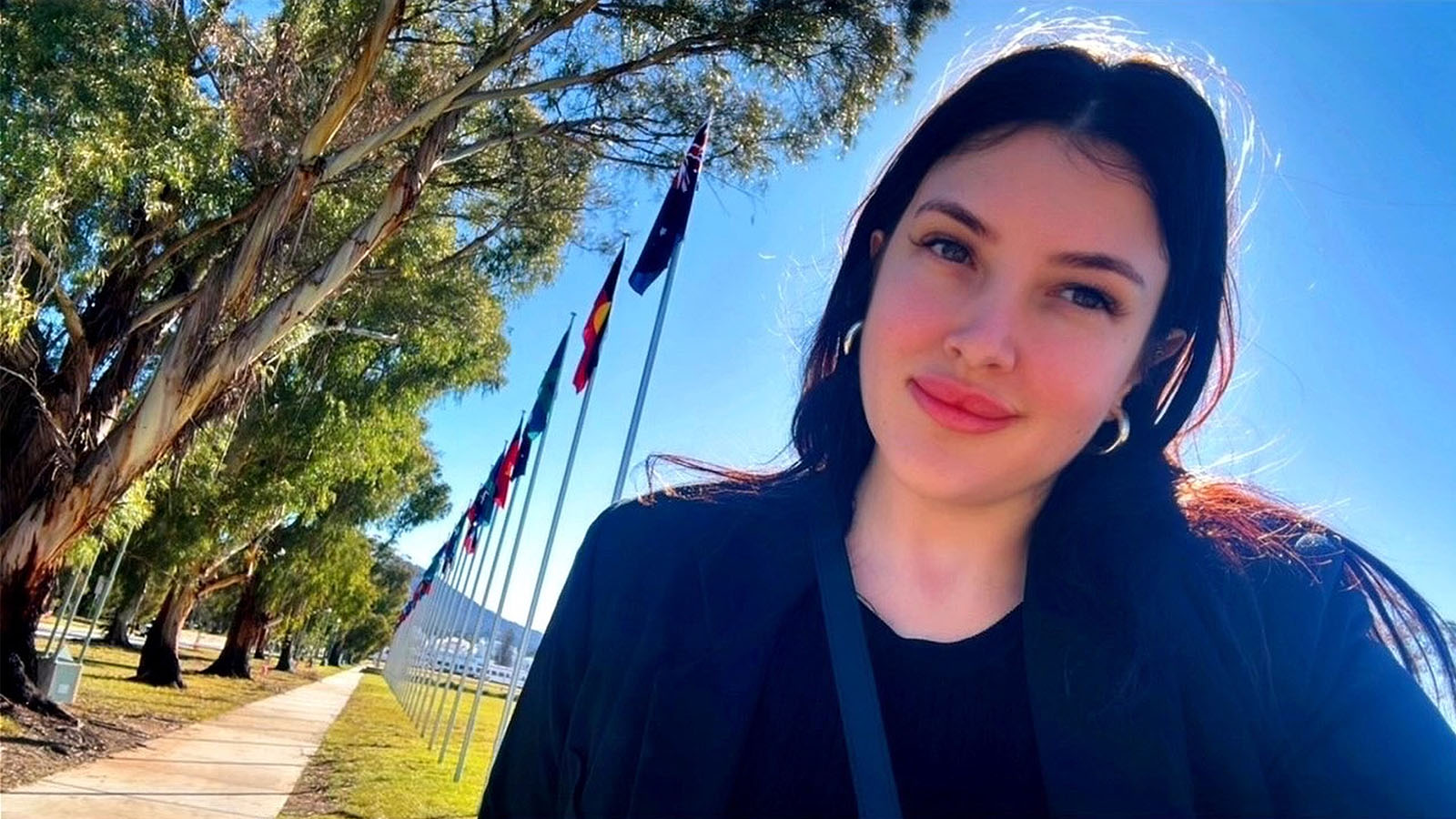
“It gave me more insight, more challenges, more opportunities to overcome unconscious bias, prejudices or scepticism,” she recalls.
Then, she decided to challenge herself even further, taking a leap of faith to move to London and start her own consultancy firm, working with organisations across London’s cultural sector, international engineering firms and luxury brands.
It was during this career move that Abby learnt storytelling was an important tool in her arsenal, and after COVID led her back home, she wanted to learn more and formalise her experience. Completing a Master of Business Administration at Sydney Business School, UOW, Abby learnt how turn ideas into action.
“The master’s program at UOW formalised my understanding and applications of cross-sectional skills. The values at UOW, the professionals and faculties really speak to who I am as a person."
The 2 per cent problem
Women account for only 2 per cent of all trade-qualified workers. Men in construction industries earn on average 31.8 per cent more than their women colleagues, making it the largest gender pay gap of any sector in Australia.
Tradeswomen Australia is hoping to change these stats.
“Tradeswomen Australia is a not-for-profit organisation that is dedicated to empowering and enabling women in trades. And not just the women in trades, but also the men that support them,” Abby says.
Support for women in trades can look vastly different to the support given to men. It can include mentorships, placements or scholarships, but most importantly, it involves a culture shift, with a lot of Abby’s role centred around education.
We’re at a crucial crossroads in Australia right now. We can accept that retention is the new recruitment or keep re-hiring without fixing psychosocial safety issues, and maintain ‘invisible’ issues that create high-churn.
Australia's blind spot
However, there is a difference between being under-represented and being invisible. A distinction that is central to Abby’s work at HerSpace.
According to the 2023 Global Slavery Index, an estimated 41,000 people were living in conditions of modern slavery in Australia on any given day in 2021.
This figure might come as a shock to many Australians, which Abby is not surprised by.
"We have an opportunity in Australia to re-socialise the topic of slavery and slavery-like practices. It is entirely understandable that in a country like ours, many would scoff at the idea that slavery exists.
“But the truth is, it’s accurate terminology. There is a lack of appropriate education and storytelling on what it is. Exploitation is often a more accessible word to socialise the issue.”
Slavery and slavery-like practices encompass a range of scenarios where one does not have autonomy or independence. It can take on many forms like forced labour, human and sex trafficking, forced marriage, debt bondage and servitude.
Abby explains that this can span recruiting someone for a job under the pretence that it is paid employment, but it’s under coercion, to forcing someone to work off a hypothetical debt.
“We walk past slavery practices in our public spaces without realising it. Inside shops, people are being held hostage to invisible or real debts, attempting to work off coercive control via obedience and acquiescing for survival. This is harrowing, as we know what we stand for here in Australia - and it certainly is not that.”
“If anyone ever asks you what slavery in Australia is or what it could look like, tell them it’s the absence of autonomy.”
The journey to recovery
The effects of modern slavery on survivors can be profound, and HerSpace has just published a suite of helpful tools and materials for the public, health practitioners and all Australians alike.
“Post traumatic stress disorder (PTSD) is more socialised now, but something I want to plant in the minds of everyone is the prevalence of Post Traumatic Stress Growth (PTSG).”
“This is where truly incredible, rapid and long-term growth can happen born from adversity. The key, however, is access to appropriate periods of time for restoration, reflection, integration and then, survivors can flourish.”
Abby says many survivors find peace and growth from on-going counselling sessions, while others respond to other creative modalities like music and dance therapy.
“It can be very helpful in recovery for expression. It's a reclaiming of autonomy, self-expression and dignity.”
Another way HerSpace helps is through awareness and education. It works closely with frontline workers, service designers and policy makers on trauma-informed approaches to modern slavery response and care.
How you can help
HerSpace has a three-part mission: raising awareness of exploitation in Australia, securing anti-slavery supply chain commitments from corporations large and small, and generating donations to fund recovery services.
One of the simplest and easiest ways to help survivors of modern slavery is donating. This allows HerSpace to continue its work in recovery support, advocacy and education.
Abby believes education is the best form of prevention, as some groups are more susceptible to exploitation, particularly if they have been vulnerable for long periods of time.
“Whether that's because of drug abuse, poverty, or violence in the home, the risk increases for slavery and slavery-like practices. But also, for perpetrators, their risk of offending goes up the more that they are in vulnerable circumstances too.”
Modern slavery is often silent and hidden in plain sight. The signs that someone could be experiencing exploitation are subtle. It could only be in their clothing, mannerisms and body language, that signal something is amiss.
If you suspect someone is victim of slavery and slavery-like practices, Abby advises that the first step is to get assistance from the police or services like 1800-RESPECT.
“Quite often people who are in this position are vulnerable and monitored. These services can help you to discern what you're seeing, what is problematic, and create a reference note.
“It is important to register what you’re feeling and seeing. Make documentation, even write it down for yourself, particularly if it’s a pattern and report it.
“If you’re unsure, don’t just sit with the information, do something about it.”
A conversation worth having
Abby believes that meaningful change begins with the courage to speak about issues that make people uncomfortable. These conversations are not only key for awareness, but critical to the healing and recovery of survivors.
When topics like slavery and exploitation remain taboo, the burden of visibility unfairly falls on those who have experienced the most harm.
“They've already had to be exceptionally strong and resilient. I don't think that it's fair to expect them to continue to highlight that it’s real, it happens and why we should care.”
Instead, Abby encourages people to talk about the confronting and complex realities, even if it feels clunky and imperfect.
“We need to sort of equip ourselves with a little bit more courage to attempt these conversations. The more we practise these conversations together, the better we'll get at accuracy,” she says.
“Progress is more important than perfection.”
At its core, this work is about ensuring women have real pathways to safety, autonomy and opportunity, and recognising that these outcomes benefit society as a whole.
“We can all agree that we all deserve dignity. The more pathways for women to access the opportunity to live in a dignified manner, everybody benefits.”
Want to hear more from Abby? She will deliver a MBA masterclass Retention is the Strategy in June 2026, and will also led a masterclass on Modern Slavery in Australia later in 2026.