

Beyond the headlines: Real talk on crime and community
UOW criminologists advocate for primary prevention
October 7, 2026
As true crime documentaries top the streaming charts and news headlines sensationalise gender-based violence and youth crime, criminologists encourage evidence-based reporting and primary prevention.
Content warning: This article contains discussion of crime and violence including forced marriage, and domestic, family, sexual and gender-based violence.
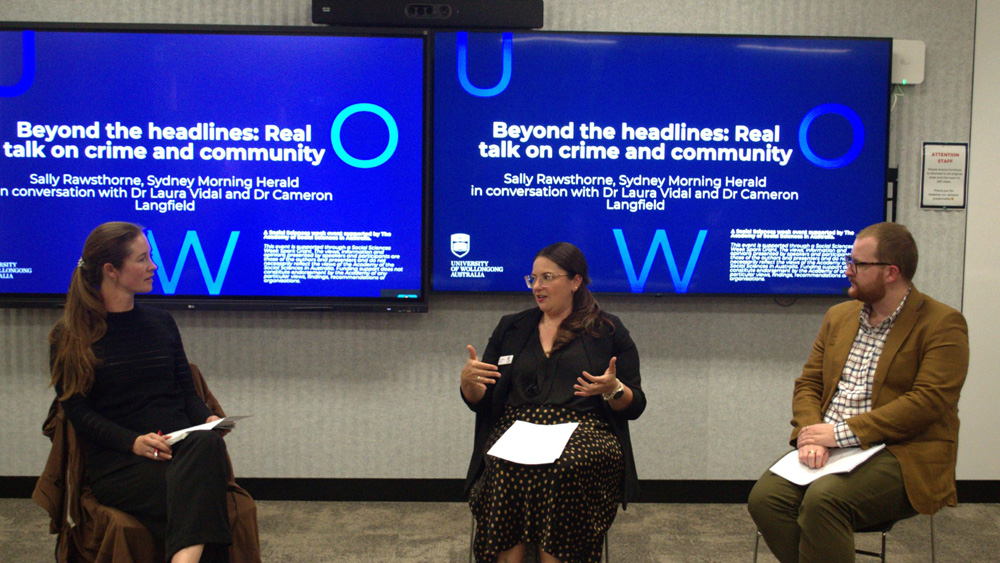
Unpacking misconceptions about crime, justice and safety was at the top of the agenda at a recent Social Sciences Week community event at UOW Liverpool, ‘Beyond the headlines: Real talk on crime and community’. Hosted by Sydney Morning Herald reporter Sally Rawsthorne, the event with UOW criminologists Dr Laura Vidal and Dr Cameron Langfield aimed to help attendees separate fact from fiction. The discussion explored the realities of crime and violence, the implications of tragedy as entertainment, and what the evidence tells us about keeping communities safe.
Is youth crime really getting worse?
Kicking off the conversation, Ms Rawsthorne asked the experts what they see as the biggest myths about crime that people continue to believe. With his focus on developmental and life-course criminology, community perceptions and youth crime, Dr Langfield addressed the misconception that youth crime and violent crimes are spiralling out of control.
“In New South Wales alone, crime is down by about 30% over the last 20 years,” he said, explaining that since the 2000s there has been a decline in the amount of people known to police, particularly in younger cohorts.
This doesn’t mean crime is disappearing, but a smaller group of people are committing a similar number of offences. Dr Langfield said research shows a polarisation or concentration of offending. While non-violent crimes such as theft and break-ins have declined, violent offences have remained more persistent.
Part of that change, Dr Langfield explained, is due to improvements in security. Cars are harder to steal, homes are better protected, and many of the goods once targeted by thieves have been replaced by digital services.
“No one wants a stolen DVD player anymore when everything's online.”
At the same time, media coverage naturally focuses on exceptional and violent incidents rather than the countless places where crime is not occurring.
“The media focuses on sensational details because they sell,” he said. “We always hear about violent crimes or crimes where the offender is, for example, not white.”
The result is a public narrative that can feel disconnected from long-term trends.
Tragedy as entertainment and exploitation
If perceptions of crime are shaped by the media, true crime has become one of the most influential storytellers of all, as streaming platforms and social media feed an enormous appetite for crime content.
“While raising awareness and engaging with how crime happens and how people are harmed is important, there is a myth around how effective it is,” said Dr Vidal, who specialises in systemic responses to harm, including modern slavery, forced marriage and domestic violence. “Research tells us media attention often creates significant harm and secondary victimisation for the person who experienced the harm, their family and loved ones, and other victim-survivors of similar crimes.”
She added that there has been a recent uptick in distress and help-seeking from victim-survivors of sexual violence due to the media storm around sexual violence.
The difference, she argued, often comes down to timing, how the story is told, and agency.
Podcasts such as The Lady Vanishes – which was hosted by a woman whose mother has been missing since 1997 –demonstrate how media attention can help families pursue answers, reopen investigations and generate new evidence. In those instances, the people most affected retain choice and control over how the story is told. But not all true crime content operates in that way, and an expanding commercial industry has emerged around the retelling of traumatic events.
Dr Vidal spoke about a study on the portrayal of murder in true crime documentaries on the streaming service Hulu, which found that in all but one of the analysed documentaries “offenders were being positively portrayed, and victim-survivors were being harmed in the depiction”.
“It’s a concerning dynamic when we think about what it means for the community forming their perceptions based on that kind of coverage,” she said. “What message are we sending when we produce entertainment out of somebody’s tragedy?”
Those concerns are particularly pronounced in reporting on gender-based violence. While recent attention on the danger of social media algorithms and online misogyny is valid, Dr Vidal argued that mainstream media continues to reinforce harmful narratives, and victim-blaming messages and attitudes.
Ms Rawsthorne brought up a timely and relevant example, a headline from the Newcastle Herald from that same day which referred to a gang rape as a “forced threesome”.
Although primary prevention organisations have produced guidelines on how to safely report on gender-based violence and take a trauma-informed approach to engaging with victims and their families, Dr Vidal said, “we do still see overwhelming headlines that ignore the dynamics around victim choice and agency”.
Effective prevention requires a consistent understanding of how violence occurs and how it should be reported.
What causes crime?
According to Dr Langfield, offending emerges from a complex interaction between individual and societal factors – “sometimes it’s things we can't necessarily predict or respond to”. Biological influences, brain chemistry, early childhood experiences, poverty, cumulative disadvantage and social conditions have all been shown to be correlated with criminal behaviour.
“It's what we call the gene-environment interaction,” Dr Langfield said. “People who have certain genetic markers, if they're placed in a supportive, non-disadvantaged environment, are actually less likely to go on to commit crime than people who have the same genetic markers but are placed in disadvantaged environments.”
He added that there’s even a strong correlation between low resting heart rate and future offending, which could potentially be a result of feeling physiologically uncomfortable and therefore engaging in activities, such as criminal behaviour, to try to raise their heart rate.
For Dr Vidal, there’s a deeper question to answer: what is crime?
She argued that crime is a social and political construct. Some harms are criminalised while others are not, often reflecting broader power structures, cultural values and the “ideal of what creates a moralistic society”.
“There are people living in poverty who are stealing food because they're hungry. Why are they in poverty? Is it not a harm that we don't have a just society where people are fed enough that they don't need to steal to eat? Society decides what is and isn't a crime, and that's not a uniform experience.”
Dr Vidal clarified that none of this means excusing harms or suggesting that people shouldn’t be held accountable but emphasised that understanding crime means looking beyond individual actions to the systems that shape people's lives.
“To solve that crime, we need to solve the underlying cause.”
Stopping it before it starts
When asked how we can create safer communities and stop crime, both researchers said that the strongest evidence supports primary prevention. Whether discussing youth offending or gender-based violence, they emphasised the importance of intervening before harm occurs.
“If you intervene later, you've given the criminal behaviour time to entrench itself in that person's life,” said Dr Langfield. “You've also given the system time to know that individual and to have an impact on them.”
He pointed to decades of research showing that early support for disadvantaged children – particularly through initiatives that empower local communities – can dramatically reduce later contact with the justice system.
Dr Vidal highlighted Australia’s primary prevention framework, Change the Story, which identifies gender inequality as a primary driver of violence against women.
“It's all linked to how we structure our society, which keeps certain people in certain places,” added Dr Langfield.
Addressing gender and economic inequality, however, requires long-term social and cultural change, something that often sits uncomfortably alongside short political and media cycles.
"Investment prior to harm occurring is where the evidence does show we need to be," she said. Yet prevention rarely generates immediate headlines or political wins.
“We need multi-level, complex solutions that need to be implemented over years, across multiple terms of government,” said Dr Vidal. “And there's no structure or mechanism in Australian policy-making that allows for that kind of long-term sustainable change.”
Dr Langfield described cycles of moral panic prompting governments to introduce a law, which the government and media then celebrate as a successful outcome. “As though there's a direct correlation between the law and the behaviour changing – which is obviously not necessarily the case.”
When asked by an audience member about the effectiveness of consent education in high school, Dr Vidal said it’s not enough to give one or two lessons. “What works in behaviour change is sustained effort over a protracted period of time, at different life stages.”
Additionally, Dr Vidal said we need to work with communities to engage in diverse ways with how people see the world to educate and encouraging social change, rather than taking a punitive approach.
“A community-grounded approach to social behaviour change isn’t popular, it costs money and time, and it doesn’t create a headline anything like ‘Woman jailed for forcing her daughter into marriage’.
Rethinking justice
The discussion inevitably turned to one of the most challenging questions in criminology: what does justice actually look like?
Drawing on her research into human trafficking and slavery, including forced marriage, and gendered violence more broadly, Dr Vidal noted that victim-survivors do not always define justice in the same way as the legal system. Some prioritise accountability and safety. Others want healing, behaviour change or opportunities to prevent future harm.
That tension becomes particularly visible when young people commit serious offences. While communities understandably demand strong responses, both speakers questioned whether incarceration alone delivers the outcomes society hopes for. Evidence suggests that imprisonment can reinforce criminal behaviour rather than rehabilitate it, especially when intervention comes only after patterns of offending have become entrenched.
Instead, emerging initiatives across Australia are exploring alternative ways for victim-survivors to engage with the justice system, particularly in cases of sexual violence. These approaches aim to provide greater choice, reduce retraumatisation and better reflect the varied ways people understand justice and safety.
Ultimately, if we want meaningful solutions to crime, we need to look beyond the headlines. The stories that dominate news feeds may capture our attention, but lasting change depends on engaging with the deeper social, cultural and structural issues that shape harm in the first place.
This event was supported through a Social Sciences Week Spark Grant. The views, information and opinions presented by speakers and participants are those of the authors and presenters and do not necessarily reflect the views of the Academy of the Social Sciences in Australia. Funding support does not constitute endorsement by the Academy of any particular views, findings, recommendations or organisations.